- You are here:
-
Home

-
News
-
Latest News
- What's Up? December 2026
What's Up? December 2026
December brings some of the year's most spectacular night-sky sights, with the return of familiar winter constellations and the peak of the dazzling Geminid meteor shower. Discover the Orion Nebula, a stellar nursery where new stars are born, spot the colourful stars of Orion and explore the winter constellations. There's also plenty to look forward to among the planets, with Saturn shining in the evening and Jupiter and Mars appearing before dawn. Wrap up warm and discover what's happening in December's skies!
What’s Up December 2026
December is a fantastic time of year for stargazers, with long, dark evenings and the winter sky at its sparkling best.
Constellations
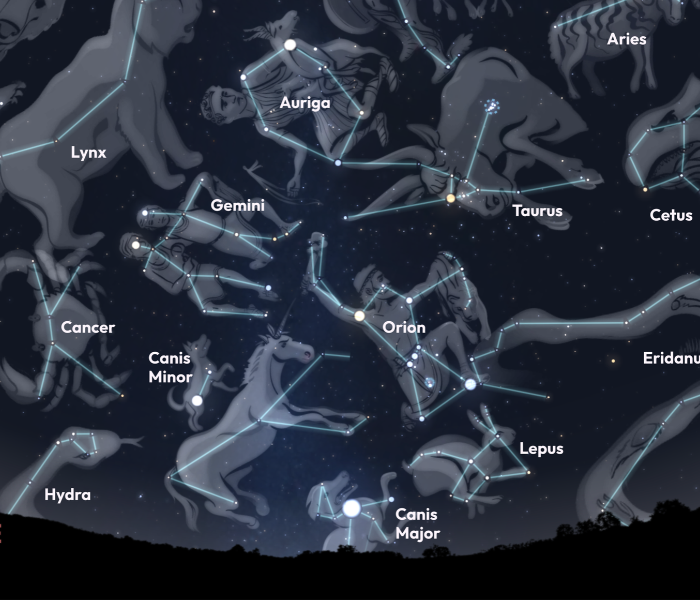
The southeastern sky with this month’s seasonal constellations. Credit: Stellarium.
Start by looking south for Orion, the unmistakable Hunter. Look closely at his two brightest stars: red-orange Betelgeuse marks his shoulder, while blue-white Rigel shines at his foot. Their colours reveal their temperatures, with cooler stars glowing red and orange and hotter ones burning blue-white. Follow his three-star belt down and to the left to find Sirius, the brightest star in the night sky. It's often twinkling in flashes of red, white and blue as its light is tossed about by our atmosphere.
Look high overhead for Gemini, home to the bright "twin" stars Castor and Pollux. Keep an eye out in mid-December too, as the Geminid meteor shower peaks around 13–14 December. It is one of the year's most reliable displays, with bright, slow meteors streaking across the sky. The meteors can appear anywhere in the sky, but if you trace their paths backwards, they will appear to emanate from Gemini.
Finally, look for Auriga, the Charioteer, riding high in the sky with golden Capella blazing at its head. Its pentagon shape is easy to spot, and it holds several star clusters that are lovely through binoculars.
Object of the Month – The Orion Nebula (M42)
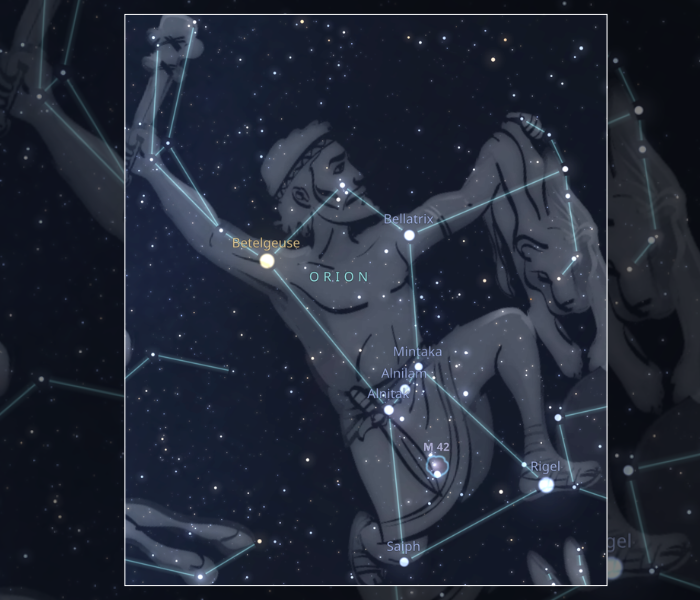
A close-up of the constellation Orion. Credit: Stellarium.
Hanging from Orion's belt, the "sword" contains a fuzzy glow that's actually a stellar nursery, where new stars are forming around 1,300 light-years away. You can spot it with the naked eye from a dark site, but binoculars reveal a glowing cloud, and even a small telescope picks out the Trapezium, a tight knot of young, hot stars lighting up the nebula from within.
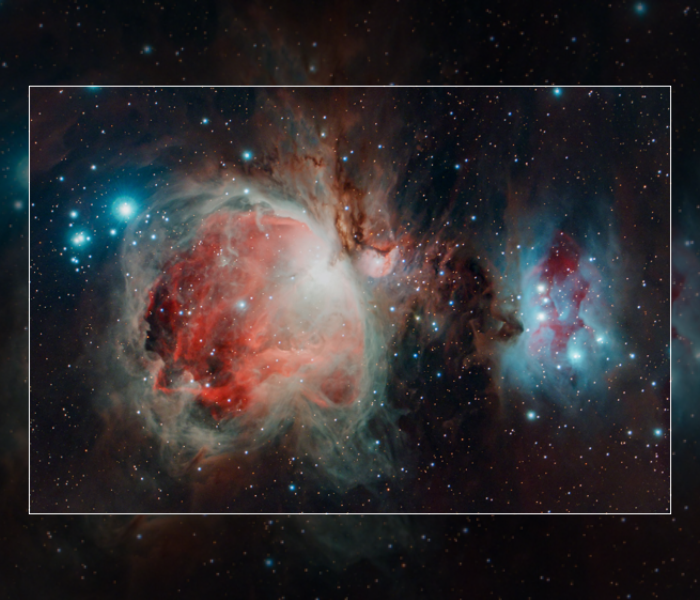
The Orion Nebula. Credit: Adam Shore, Astronomer and Education Lead at Kielder Observatory.
The Geminids: December’s Shooting Star Spectacular
The Geminids are the highlight of the meteor year, peaking on the night of 13–14 December. Under dark skies you could see up to 100 meteors an hour at the peak, and they are often bright, slow-moving and colourful.
They are also a bit of an oddity. Most meteor showers come from comets, but the Geminids come from an asteroid called 3200 Phaethon, a rocky body about 5 km across that swings closer to the Sun than any other named asteroid. As Earth ploughs through the trail of dusty debris it leaves behind, grains no bigger than a pea slam into our atmosphere at around 35 km per second. The meteor itself isn't burning. The grain is heated so fiercely that it vaporises, and the surrounding air is energised too, glowing as it is stripped of electrons.
That's where the colour comes from. Different elements glow at different wavelengths as they vaporise: sodium gives a yellow-orange glow, magnesium a blue-green, calcium a violet tint and iron a yellow one. Excited oxygen and nitrogen in the air add their own greens and reds. Because Geminid grains are denser and rockier than the fluffy dust of comets, they tend to survive longer and shine brighter, giving the shower its famously rich colours.
To watch, find a dark spot away from streetlights, wrap up warm and lie back, giving your eyes around 20 minutes to adjust. You don't need a telescope or binoculars. The meteors appear to radiate from Gemini, near Castor and Pollux, but they can show up anywhere, so take in a wide patch of sky rather than staring at one spot.
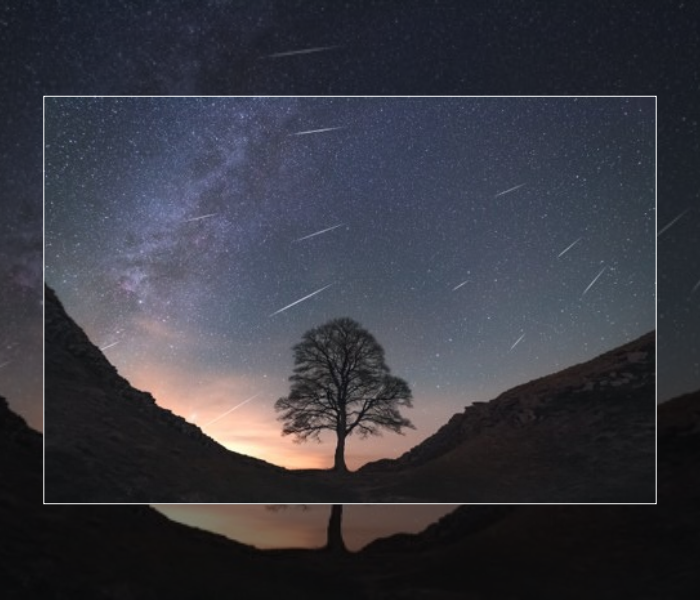
A photograph of Sycamore Gap, taken while the tree was still standing, showing eleven shooting stars during the Geminid meteor shower. Credit: Dan Monk, Director of Astrophotography at Kielder Observatory.
Planets
Saturn is the planet to look for in the evening, shining in the southern sky after sunset in the constellation Pisces. To the naked eye, it appears a steady, yellowish "star" that doesn't twinkle, and a small telescope will show its rings. Neptune sits just to its right, though you'll need binoculars or a telescope to find it. Saturn is at its best early in the month, with the Moon passing close to it around 17–18 December.
Night owls and early risers are in for a treat this month. Jupiter and Mars are in Leo, near the bright star Regulus. Jupiter is the brilliant, creamy-white one, and Mars is the fainter, rusty-red one. Through binoculars or a telescope, Jupiter will provide an extra gift for observers: the Galilean moons! Io, Europa, Ganymede and Callisto are all large enough to be easily observed, changing positions every night. Both Mars and Jupiter are visible in the eastern sky before dawn. Look out for the Moon joining them around 26–28 December.
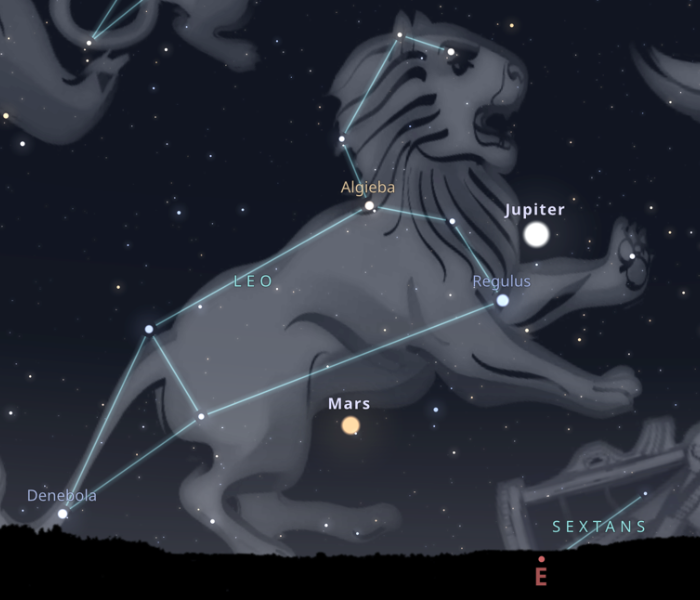
The constellation Leo rising in the eastern sky, showing the positions of Mars and Jupiter in relation to the constellation and each other. Credit: Stellarium.
Moon Phases
We always recommend planning your stargazing around the phases of the Moon. To observe deep-sky objects, the darkest skies will be those between the last and first quarter, around the New Moon.
Last Quarter: 3 December
New Moon: 9 December
First Quarter: 17 December
Full Moon: 24 December
Happy Stargazing!