- You are here:
-
Home

-
News
-
Latest News
- What's Up? November 2026
What's Up? November 2026
November brings the return of winter favourites, with the Double Cluster in Perseus sparkling overhead and the Leonid meteor shower reaching its peak on 17–18 November. Look out for a close pairing of Mars and Jupiter, while Saturn continues to shine in the evening sky. The month rounds off with a spectacular Beaver Supermoon – plenty of reasons to look up as winter approaches!
What's Up? November 2026
Hello and welcome to our monthly What's Up article. This month, get ready for the return of some winter favourites, a meteor shower, a planetary conjunction and a supermoon!
Constellations
Let's have a look at some autumn classics before they disappear, with winter just around the corner.
Perseus
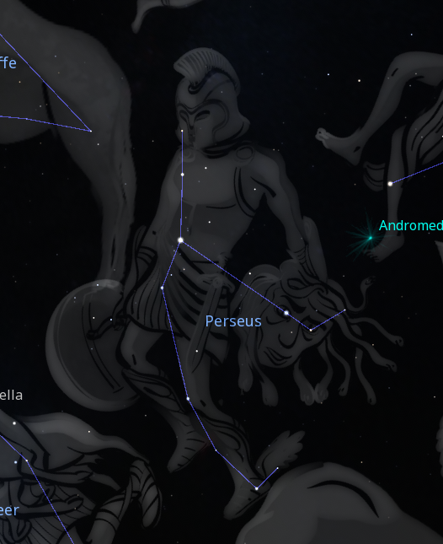
Image: Constellation Perseus. Credit: Stellarium.
Perseus is close to the zenith at this time of year and is an easy constellation to find in the night sky. To locate our Greek hero, first look for the 'W' shape of Cassiopeia. Perseus can be found towards the bottom left of the 'W'.
Cassiopeia and Perseus are not only close together in the sky, but they are also closely related in Greek mythology. Perseus is Cassiopeia's son-in-law. After Perseus saved the princess Andromeda from one of Poseidon's sea monsters, the two fell in love and married.
Object of the Month: The Double Cluster
A fantastic object to observe in Perseus is the imaginatively named Double Cluster. It's called this because it consists of two star clusters sitting close together in the sky.
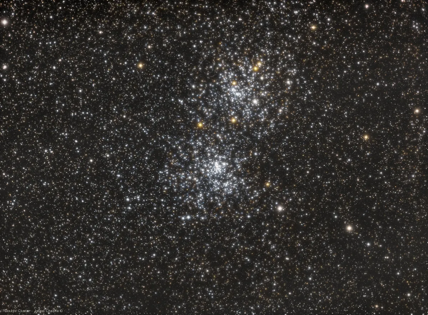
Image: Double Cluster in Perseus. Credit: BBC Sky at Night Magazine.
These clusters are approximately 7,500 light-years away and contain around 8,000 stars between them, making them bright enough to be visible to the naked eye under dark skies.
Leonid Meteor Shower
This month brings the Leonid meteor shower, which peaks on the night of 17–18 November. Usually a relatively quiet shower, you might be able to spot around 10–15 shooting stars per hour under ideal conditions.
The Leonids are particularly famous because, in some years, they have produced spectacular displays. The comet responsible for this meteor shower, 55P/Tempel-Tuttle, has a relatively short orbital period of around 33 years, and its orbit intersects with Earth's. As the comet travels around the Sun, it leaves behind trails of debris. When Earth passes through particularly dense parts of these trails, we can experience meteor storms, with thousands of meteors appearing every hour.
The last major Leonid meteor storm occurred in 2002, and we'll have to wait until around 2031 for another potential spectacular display.
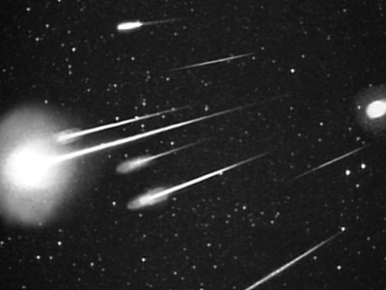
Image: Leonid Meteor Shower. Credit: NASA.
Planets
Saturn will maintain a prominent position in the sky in Pisces. But for those willing to stay up a little later, Mars and Jupiter will also be visible after midnight.
On 16 November, and for a few days either side, Mars and Jupiter will appear approximately one degree apart in the constellation of Leo. This will be a fantastic pairing to spot with the naked eye, as well as through a small telescope or binoculars.
You should be able to distinguish the difference in colour and brightness between the two planets. Jupiter will appear very bright and white, while Mars will be a little dimmer with a more yellowish-red colour.
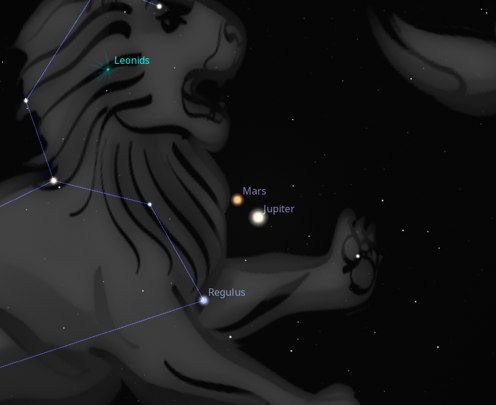
Image: Conjunction of Mars and Jupiter.
Moon Phases
Third Quarter: 1 November 2026
New Moon: 9 November 2026 (7:02am)
First Quarter: 17 November 2026 (11:48am)
Full Moon: 24 November 2026 (2:54pm – Supermoon / Beaver Moon)
Third Quarter: 1 December 2026
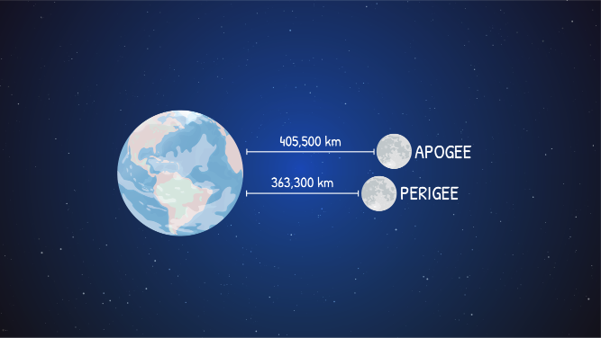
This year's Beaver Moon will also be a Supermoon! This means the Moon will be slightly closer to Earth than usual, making it appear a little bigger and brighter in the sky.