- You are here:
-
Home

-
News
-
Latest News
- Whats Up? October 2026
Whats Up? October 2026
October brings darker evenings and plenty to explore in the night sky. From Pegasus and the Andromeda Galaxy to Saturn at opposition and the return of Orion, there’s plenty to keep an eye out for this month. And, of course, the Orionids meteor shower makes an appearance too.
What’s Up? October 2026
Once upon a midnight dreary, while I pondered, weak and weary,
Over many a quaint and curious volume of galactic lore—
While I nodded, nearly napping, suddenly there came a tapping,
As of some one gently rapping, rapping at my observatory door—
“’Tis some visitor,” I muttered, “tapping at my observatory door—
Only this and nothing more.” – E. A. Poe (kind of)
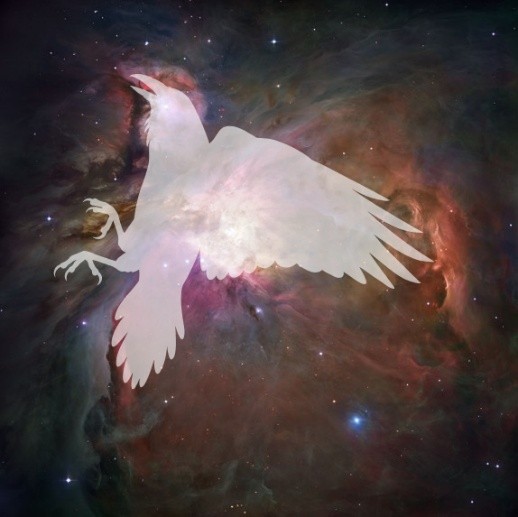
We have our fingers crossed for very few dreary midnights this month, because there’s plenty to look out for in the sky! Not least of all is the return of the Orion Nebula, which I have always thought resembles a bird. Perhaps a certain stately raven?
Constellations
As much as I would love to keep the raven thing going, the constellation of Corvus does not make a visit to our night-time skies in October. So, in its absence, we’ll start with another winged animal – Pegasus!
Pegasus is best known for its Square, formed by four bright stars that represent the body of the winged horse (although Alpheratz is technically considered part of Andromeda these days). Within the Square of Pegasus lies a challenge: how many stars can you see?
This is a great way to determine how dark your skies are and how sharp your vision is. If you want to do the proper test, find a map of the stars in Pegasus and a list of their magnitudes in ascending order. The greater the magnitude, the fainter the star. Simply make your way through the list, using the map as a guide for where to look.
From light-polluted skies, you may only tick off one or two stars, but from dark skies under good conditions, you could see upwards of 30. Finding the magnitude of the faintest star you can see in Pegasus can be really useful as you continue on your astronomy journey. It gives you your limiting magnitude – a number you can keep in mind when deciding what to look at, as it indicates what you may be able to see.
Joining Pegasus in the southern region of the sky in October are Pisces, Cetus and Aquarius. None of these constellations are renowned for their bright stars, but this makes it all the better for spotting Saturn, which will appear as a solitary point of brightness.
Saturn is best seen through a telescope or pair of binoculars, so if you have some lying around, it’s time to dust them off and get them outside. Last year, Saturn sat edge-on to Earth, giving its famous rings a more line-like appearance. This year, Saturn is bowing to us and the rings look a little more... ring-y!
On 4 October, Saturn will reach opposition. This is the point where a planet is directly opposite the Sun in the sky, meaning Saturn will appear particularly bright and will be ideally placed for observation.
In the western sky, we see summer disappearing as the Summer Triangle dips lower and lower each night. Meanwhile, in the east, we see winter beginning to rise, with Taurus, Gemini and Orion climbing higher as the month goes on.
Starting around 2 October, we also have the Orionids meteor shower, which will peak around the 21st, with a rate of around 15–20 meteors per hour under ideal conditions. The Orionids are one of two meteor showers associated with Halley’s Comet. While the comet itself is not due to be seen in our skies again until 2061, you can spot it on the Bayeux Tapestry, which is in England for the first time in nearly 1,000 years!
Objects of the Month – Vesta and Andromeda
On 13 October, the asteroid Vesta will be at its best as it reaches opposition. As mentioned earlier regarding Saturn, at opposition an object is opposite the Sun and is ideally placed for observation.
At opposition, Vesta will be around magnitude 6.7, making it too faint to see with the naked eye, but it should be well within the capabilities of a telescope.
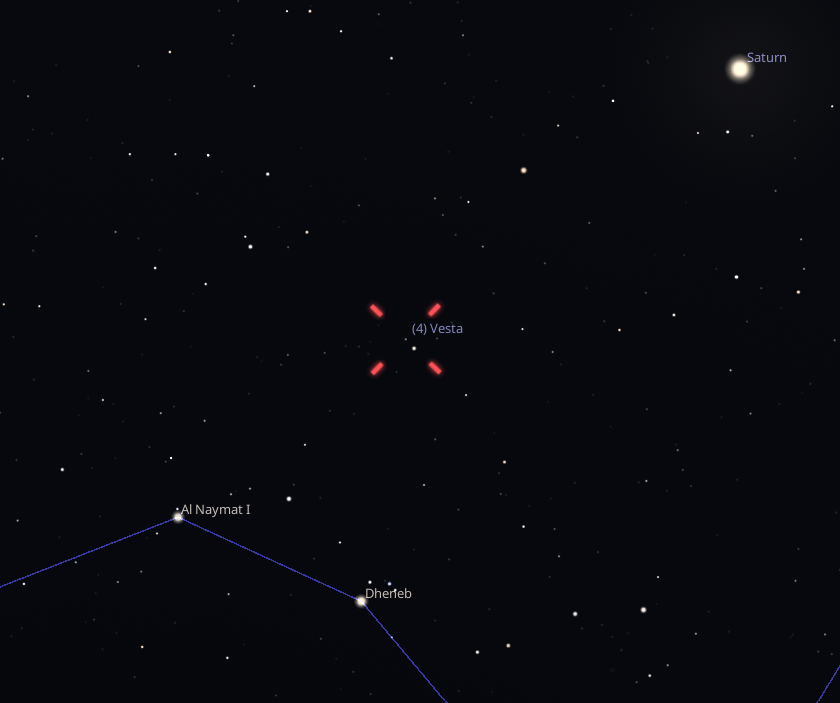
Vesta is the largest asteroid in the asteroid belt and, through a telescope, will appear as a small grey-silver point of light. Finding it may prove a little tricky, but if you can locate Saturn and the star Al Naymat I in the background of Cetus, Vesta should be about a third of the way between them, just next to a star.
If Vesta is proving too elusive, then you can go for a galaxy instead – it’s Andromeda season!
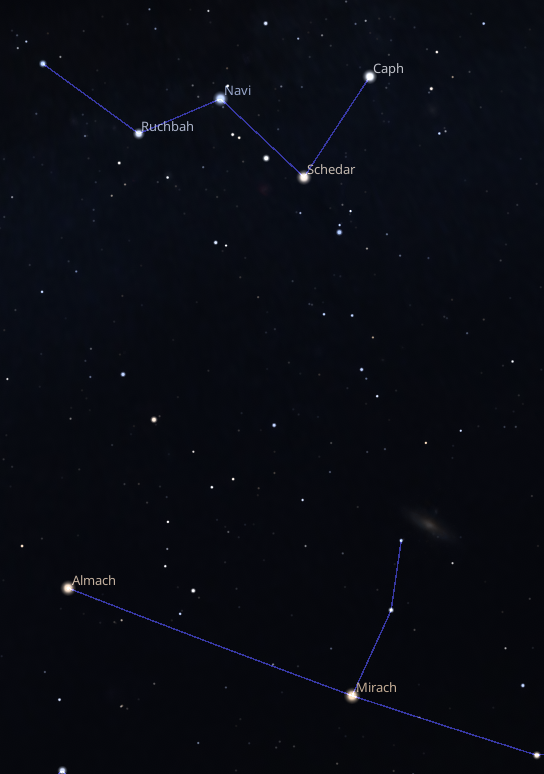
After a long summer of languishing low in the northern skies, our galactic neighbour will be climbing higher towards the east at sunset and reaching its highest point in the south around midnight. At magnitude 3.4, Andromeda should be visible to the naked eye from dark skies, and it can be located with a little help from Cassiopeia.
Use Caph, Schedar and Navi as an arrow and they will point you towards the orange star Mirach in Andromeda. Once you can see Mirach, look for the fainter star just above it and then hop the same distance in the same direction to find the galaxy.
Although the Andromeda Galaxy is visible to the naked eye, it is faint and will appear as a fuzzy smudge in the sky. You may even struggle to see it when looking directly at it. Instead, try looking slightly to one side – you may find it becomes easier to see out of the corner of your eye.
If you find yourself averting your eyes for a better view, you are actually using a common astronomy trick known as averted vision!
Planets
As previously mentioned, Saturn is the main star (not a star!) this month and will maintain a prominent position in the sky just below Pegasus. But for those ready and willing to stay up a little later, Mars and Jupiter are on their way back into our morning skies.
Mars will rise with Cancer after 1am at the start of the month and after midnight towards the end of the month, following the clocks going back. Jupiter will follow shortly after in Leo.
The Moon
Third Quarter: 3 October
New Moon: 10 October
First Quarter: 18 October
Full Moon: 26 October