- You are here:
-
Home

-
News
-
Latest News
- What's Up? September 2026
What's Up? September 2026
September marks the return of longer, darker nights, bringing a whole host of celestial favourites back into view. From the Summer Triangle and Milky Way to the Pleiades, M13 and the Andromeda Galaxy, there’s plenty to explore... while Saturn takes centre stage in the evening sky. Read our What's Up guide for September.
What’s Up? September 2026
On 23 September, the Autumn equinox will occur. As the Sun passes directly over the equator, roughly equal amounts of daylight and darkness will be experienced across the globe. From here in the Northern Hemisphere, the days will begin to get shorter and the nights longer, giving us more time to explore the night sky. Here's what to look out for:
Constellations
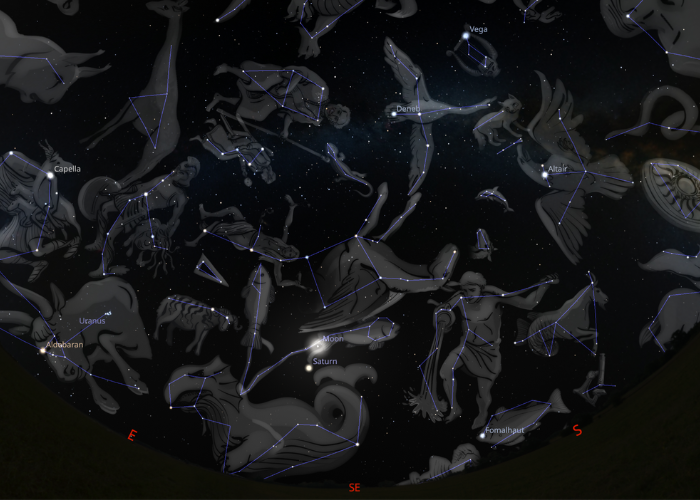
Image Credit: Stellarium
Image description: This image shows the night sky at midnight at the beginning of September, from the north-east to the south-west, displaying the seasonal constellations, with the Moon and Saturn to the south-east.
Cygnus and the Summer Triangle
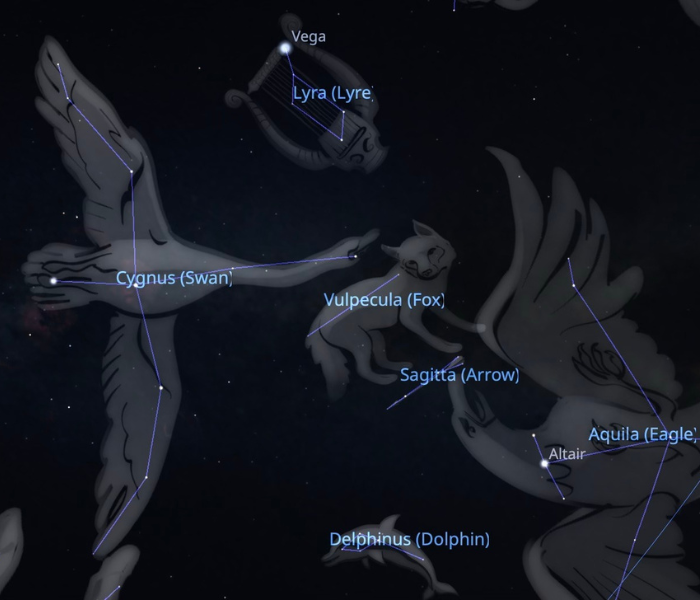
Image Credit: Stellarium
The Summer Triangle remains nicely overhead towards the south as the Autumn nights draw in. The first stars to be seen in the evening are the brightest: Deneb, Vega and Altair. Soon after, the eye of the Swan, Albireo, will become visible to the naked eye.
Albireo is a double star that can be easily split through a pair of binoculars. It is well known for its starkly contrasting components; Albireo A is an orange giant, five times larger than our Sun, and appears golden-yellow, while Albireo B is a hotter, smaller star that appears blue-white.
Early Autumn also presents a fantastic opportunity for spotting the nebulous band of our home galaxy, the Milky Way, stretching across the sky. By following the central line, or body, of Cygnus towards the south, you will be guided towards the Galactic Centre of the Milky Way. This is the densest, and therefore brightest, region of the Milky Way visible from the UK, though you will need dark, moonless (and clear!) skies to see it.
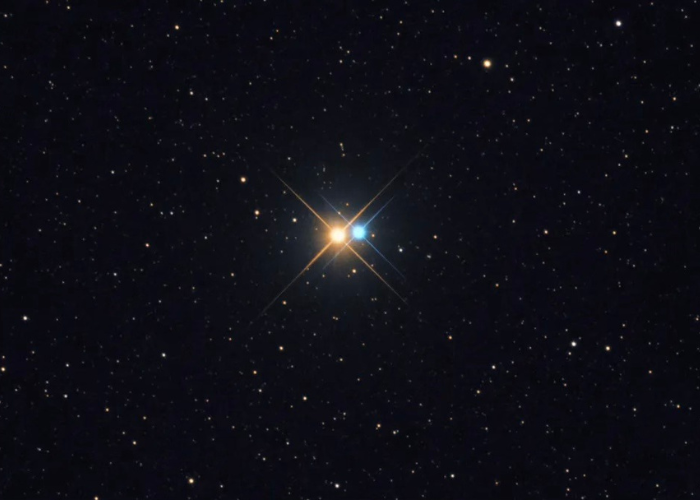
Image Credit: Kfir Simon via Tivoli Astro Farm
Image description: Albireo.
Taurus and the Pleiades
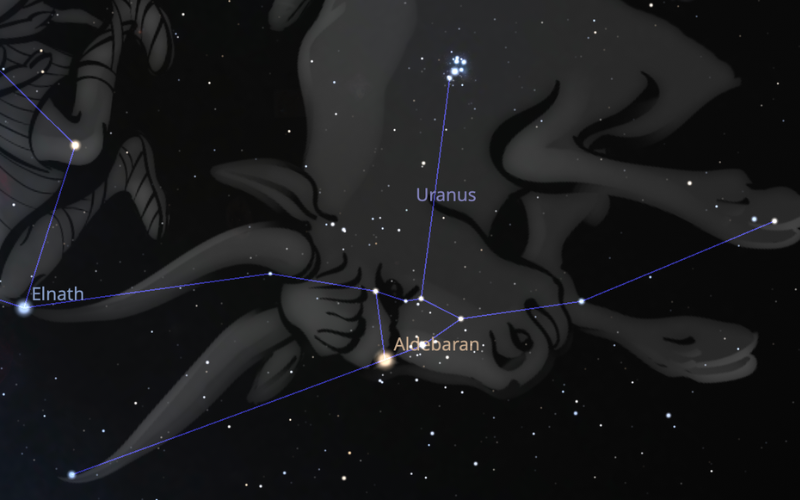
Image Credit: Stellarium
Image description: The constellation Taurus.
The return of Taurus to our night skies is a true sign that Autumn is here. Rising earlier and earlier in the east as the month goes on, the first part of the Bull to be spotted is its ‘heart’, the Pleiades.
Sometimes referred to as the Seven Sisters, this open star cluster is home to more than 1,000 young stars. As one of the closest clusters of stars to Earth, sitting just shy of 450 light-years away, it is easily visible to the naked eye. Looking directly at it, it may appear as a faint, twinkling cloud in the night sky. The best way to view this object is to use your peripheral vision. By looking just to the left or right of the cluster, you will see a much brighter and more defined image.
The ‘eye’ of the Bull, Aldebaran, is easily distinguishable as a bright, warm-toned star. Derived from Arabic, its name means ‘The Follower’, as it appears to follow the Pleiades across the night sky. To make finding this star easier, hold a closed fist out at arm’s length and place it against the night sky. The distance from your thumb to your little finger is roughly 10 degrees. Aldebaran sits about 13 degrees below the Pleiades, so your fist should just about fit between the two.
Aldebaran is a huge red giant, around 45 times the size of our Sun. Its size and relatively close distance to us make it the 14th brightest star in the night sky.
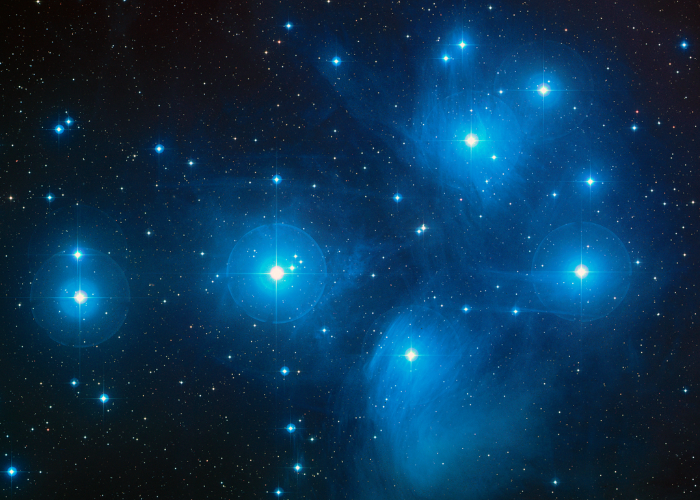
Image Credit: DSS
Image description: The Seven Sisters, colourised. These bright young stars appear an electric blue colour, surrounded by wispy clouds of gas and dust.
Hercules and the Great Globular Cluster (M13)
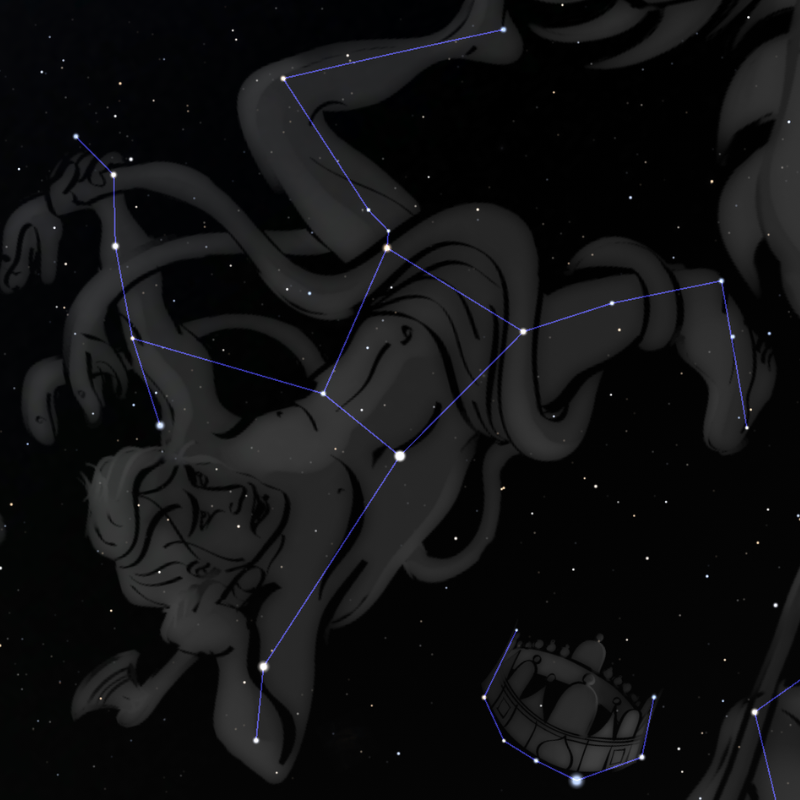
Image Credit: Stellarium
Image description: The constellation Hercules. The middle, or ‘body’, of the constellation is made up of four stars in the shape of a keystone. On the right side of the keystone, approximately two-thirds of the way up between the corner stars, sits M13.
The Great Globular Cluster in Hercules is one of the most ancient objects visible in the Milky Way, at approximately 12 billion years old. Appearing as nothing more than a faint smudge to the naked eye, through a pair of binoculars or a telescope this smudge becomes a large, round, static-like cloud.
Home to up to 500 million stars, this cluster can be found on the right-hand side of the keystone shape that makes up the body of Hercules. If you follow the line from the bottom-right star to the top-right star, M13 sits about two-thirds of the way up.
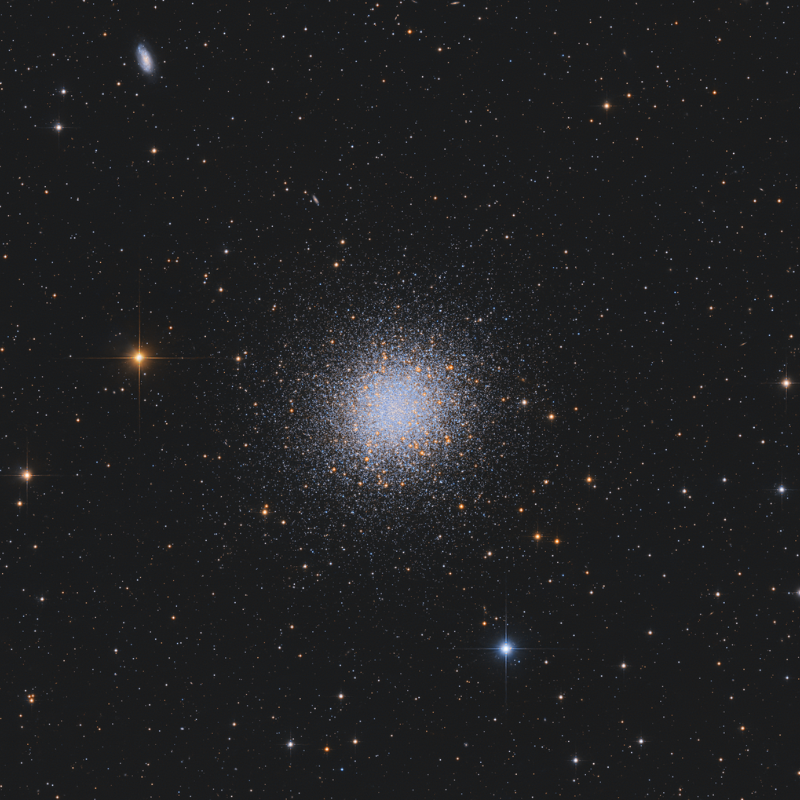
Image description: The Great Globular Cluster. A circular cluster of stars, densely packed in the centre, with the intense brightness gradually fading towards the edges.
Andromeda
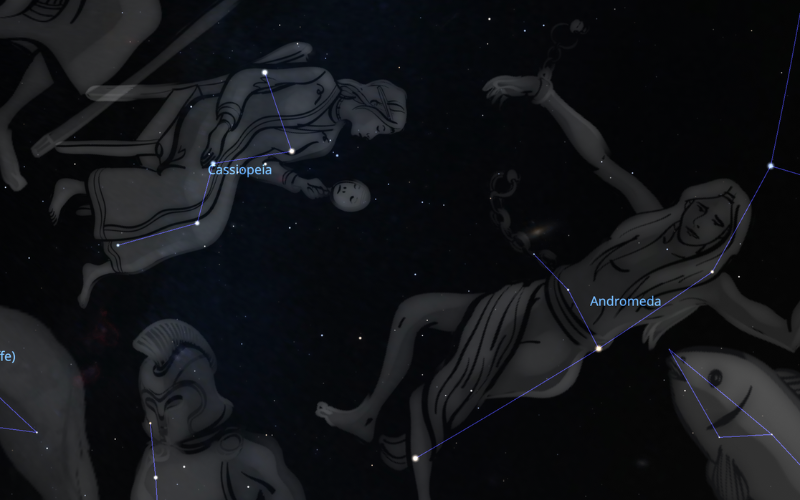
Image Credit: Stellarium
Image description: Andromeda, the princess, sits next to her mother, Queen Cassiopeia, in the night sky. At the top of Andromeda’s ‘belt’ is a faint, oval-shaped smudge. This smudge is the Andromeda Galaxy.
Since Babylonian times, the figure of a lady has been depicted in this part of the sky, though Andromeda derives her name from Greek mythology, where she is known as the ‘Chained Lady’. In Greek tradition, she was chained to a rock by the sea, only to be saved by the hero Perseus, whose head can be seen in the image above.
The three brightest stars in Andromeda, Alpheratz, Mirach and Almach, appear in an almost straight line. The middle star, Mirach, can help us find the Andromeda Galaxy. If we ‘star hop’ from Mirach to a slightly dimmer star above, back towards Cassiopeia, and then to another slightly dimmer star just above, we can spot a faint, elliptical smudge.
This object is right on the edge of what we can see with our naked eyes, but it is the furthest object we can see unaided. Our closest galactic neighbour, the Andromeda Galaxy sits around 2.5 million light-years away from us.
Planets and the Moon
Planets
For September, the star of the show is Saturn! The ringed planet rises in the east-south-east at around 9pm and remains visible for most of the night. By the early hours, it climbs high into the southern sky, shining with a steady, slightly golden light. A small telescope will reveal its famous rings and even some of its larger moons.
For those willing to stay awake a little longer, Mars will begin its ascent in the east shortly after 1am, with a distinct red glow, while Jupiter will begin to make its return at around 4am. Both will rise earlier and earlier as the month goes on. Uranus and Neptune are also visible, although a telescope will be needed to pick them out.
The Moon
Following a Full Moon at the end of August, the Moon will wane until we arrive at a New Moon on 11 September, providing a great opportunity to observe the night sky at its darkest. We’ll then see the Moon waxing towards a fully illuminated ‘Harvest’ Moon on 26 September, traditionally associated with the gathering of crops at the end of the Summer season.