- You are here:
-
Home

-
News
-
Latest News
- What's Up? August 2026
What's Up? August 2026
August is one of the most exciting months of the year for skywatchers. As dark skies return, enjoy spectacular views of the Milky Way, the peak of the Perseid meteor shower, and not one but two eclipses. From shooting stars to stunning lunar and solar events, discover everything happening in August's night sky.
What’s Up August 2026
This August will bring awe-inspiring evenings that even the most forced alliteration cannot do justice. In addition to the usual August delights of returning dark skies, rewarding Milky Way views, and raining Perseid meteors, we are treated to both solar and lunar eclipses!
Milky Way
Now approaching the end of summer, we say goodnight to perpetual twilight as the skies darken and lengthen. This enables us to see the Milky Way ribbon across the sky and glimpse the galactic center as it sets into the southern horizon.
A clear night sky showcasing the Milky Way galaxy with vibrant stars and a bright planet, set above a modern building illuminated with red lighting.
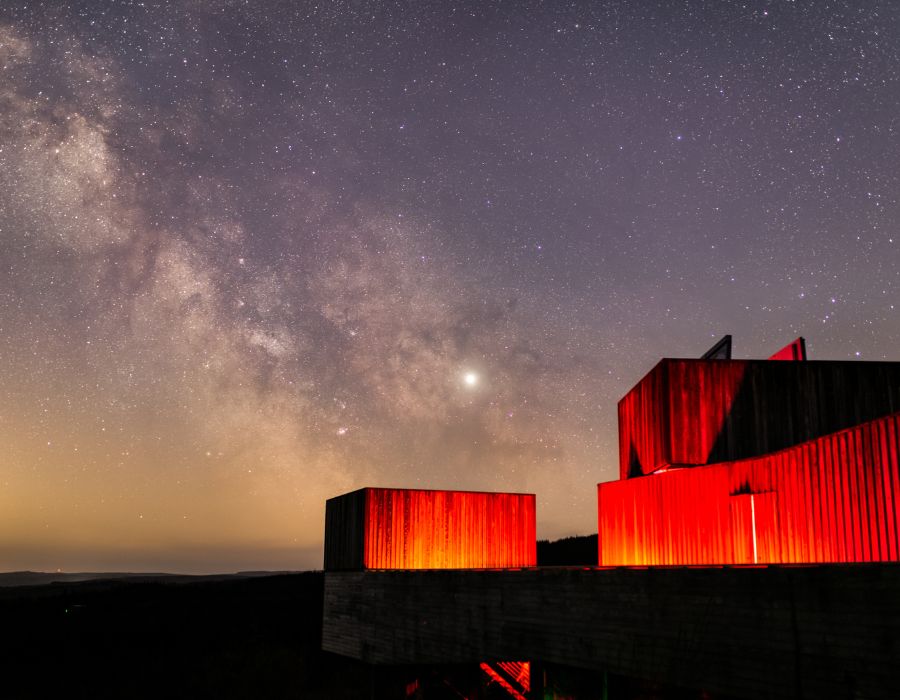
Galactic Centre Rising behind Kielder Observatory. Image credit: Dan Monk
What might be most striking about viewing the densest region of our galaxy, is what is not visible. The “Great Rift” describes the apparent gap dividing the Milky Way stretching from the constellation Cygnus to Centaurus. Giant dust clouds between our solar system and Milky Way’s centre block light, creating the dark effect. Mayan and other Southern Hemisphere cultures made dark constellations out of the shapes produced by the dust clouds blocking starlight.
To find the galactic centre, follow Cygnus the celestial swan’s dive across the night sky.
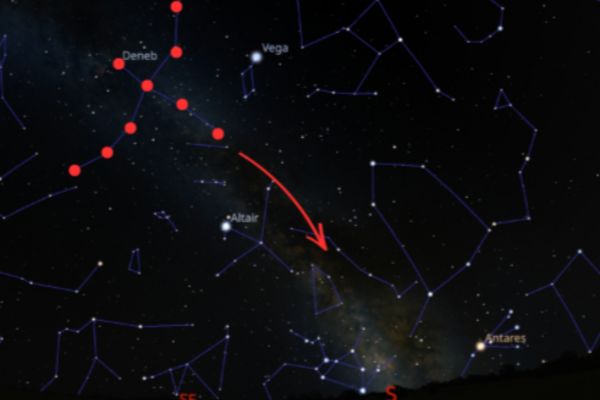
To find the densest region of the Milky Way, follow Cygnus the swan’s beak as it dives into the galactic centre. Image credit: Stellarium
Meteor Showers
The Perseids are the most active meteor shower all year and peak on 12th and 13th of August. With up to 150 meteors per hour, this shower is produced by the debris from Comet Swift-Tuttle. Though some Perseid meteors are visible up to a month prior, their occurrence falls quickly after the peak. Perseids are often bright and fast flying meteors that appear to radiate away from the Perseus constellation. The best viewing will be in the very early morning on the 12th, coinciding with the new moon to ensure extra dark viewing.
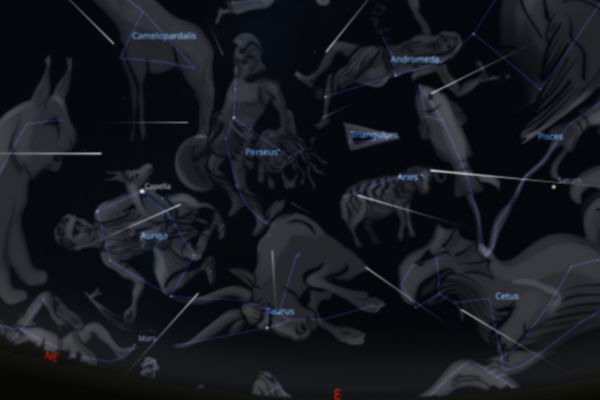
The Perseid meteors will appear to radiate away from the Perseus constellation. Meteors will be the longest in the sky about 45 degrees from Perseus. Image credit: Stellarium.
In addition to the Perseids, the Alpha Capricornids and Southern Delta Aquariids will also be visible for the first half of the month, although both less active (5 and 25 meteors per hour respectively).
Eclipses
Eclipses, both solar and lunar, occur when the sun, moon, and Earth are all aligned on the ecliptic plane.
August 12th: partial solar eclipse
When the moon slots between the sun and the Earth, it blocks the light coming directly from the sun, creating a total solar eclipse. Night seems to fall instantly as the eclipse reaches totality and the fuzzy corona of the sun glows from behind the dark moon. This will occur the evening August 12th, but totality will not be visible from the UK. Instead, depending on your location, viewers in the UK will see between 90% to 97.5% coverage. The exact timings are also location dependent, but the eclipse will between just after 6.10pm, reach the eclipse maximum around 7.10pm, and end by 8.10pm.
Viewing advice:
It is essential to use eclipse glasses or an indirect method for viewing the eclipse because just 1% of sunlight is still enough to damage our eyes. If you do not have access to eclipse glasses, you can make a small hole in cardboard and project the eclipse onto the ground or wall. You will still be able to watch the moon slowly chew away at the sun until the sun appears to be a sliver and then grow again. Colanders are a fun tool because you project dozens of little eclipses.
Because this eclipse occurs as the sun is setting, try to find a location with a low, clear western horizon. The going to the west coast could provide a low horizon, but if you are city bound, a rooftop with a view to the west may also be a good option.
The Persieds peak later this evening so if you have clear skies, stay out and enjoy after the eclipsing sun sets!
August 28th: partial lunar eclipse
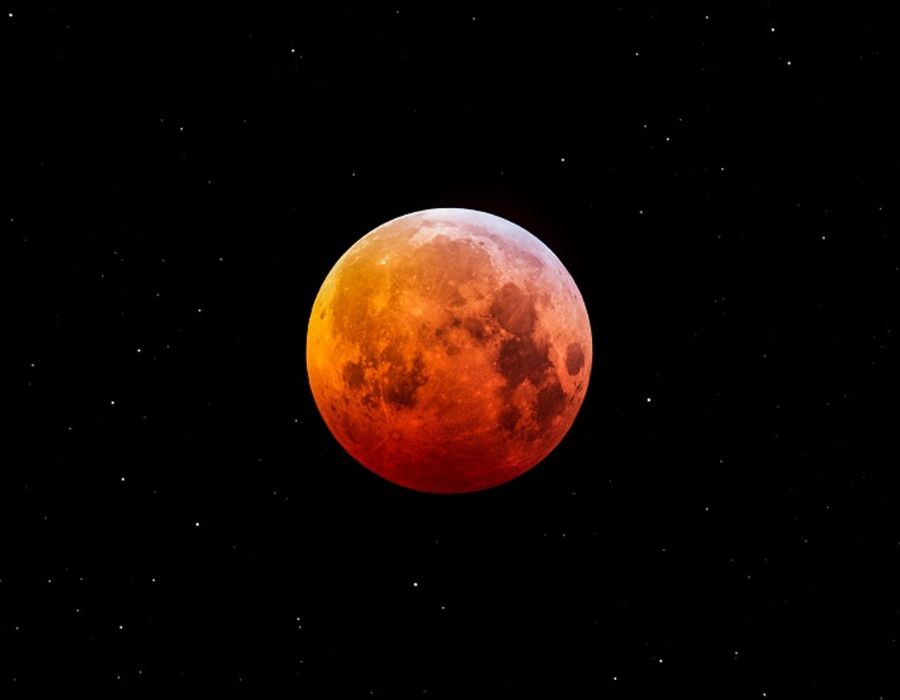
The moon glows a reddish yellow during a lunar eclipse. Image credit: Dan Monk.
When Earth slots between the sun and the moon, sunlight travels through Earth’s atmosphere to reach moon’s surface, creating a lunar eclipse. Because only longer wavelengths of light such as yellow, orange, or red can pass through our atmosphere, it’s these colours that reflect off the moon. From the UK, in the early hours of August 28th, the moon will be 93% illumined by the rusty-tinted light. From 2:24 BST, the moon will gradually appear to darken and it moves into Earth’s shadow. By 3:34 BST, the red color will begin to creep over the moon’s surface. The maximum eclipse will appear at 5:13 BST. From there the red will recede and the moon will return to its normal hue. However, because the morning is fast approaching, UK observers will not see the eclipse in its entirety.
Viewing advice:
Lunar eclipses are safe to view with the naked eye and would look lovely in binocular or a telescope.
The moon will be setting in the early twilight hours of the eclipse maximum, so be sure to find a location with a low and clear southwest horizon.
Planets
By the end of July, Saturn will have returned to the evening sky, hanging out in the constellation Pisces. Through binoculars, it will look like a slightly oblong oval, but with a telescope, its rings will be visible.
Those staying up late (or waking up early) for the August 28th lunar eclipse will be rewarded with Mars’s rise in the constellation Gemini. It will arrive in the early morning or very late-night skies by the end of the month.
Uranus is in Taurus and is rising throughout the month but is not visible without a telescope’s aid.
Moon Phases
Third Quarter: August 5
New Moon: August 12
First Quarter: August 19
Full Moon: August 27