- You are here:
-
Home

-
News
-
Latest News
- Pride in Astronomy and the Frank Kameny Story
Pride in Astronomy and the Frank Kameny Story
Frank Kameny should have spent his life exploring the stars. Instead, after being dismissed from his role as an astronomer in 1957 simply because he was gay, he became one of the leading figures in the early LGBTQ+ rights movement. His remarkable story shines a light on the discrimination faced by LGBTQ+ scientists, the impact it had on astronomy, and the progress that has been made towards a more inclusive scientific community.
Discover the legacy of the man who helped change history, both on Earth and beyond.
Image: Frank Kameny in 1948. Photo from Library of Congress.
Pride in Astronomy and the Frank Kameny Story
In 1957, a young astronomer who was working for the US Army was fired. He wasn’t fired for doing badly at his job, or for any kind of misconduct. He was fired for being gay.
He should have had a career researching the stars and making discoveries. Instead, he became one of the leading organisers of the gay rights movement.
His story shows how LGBTQ+ people were treated in science and astronomy in the past, and how far we’ve come today – and how there is still some way to go.
Introduction
Happy Pride month everyone! This month is all about celebrating the LGBTQ+ community and recognising the achievements and challenges they have faced.
Queer people have made, and continue to make, contributions to every field of science and space exploration. Whether it be Alan Turing and breaking the enigma code, James Pollack and his legendary career at NASA as an astrophysicist, or Sally Ride being the first American woman in space at the age of 32.
Today we recognise the amazing achievements of queer scientists of the past and celebrate them, however this was not always the case during their lifetimes. They were often subject to harassment and had difficulties in their careers or were denied entry into their field entirely.
The Frank Kameny Story
One of the most notable cases is that of Frank Kameny, an astronomer turned gay rights activist.
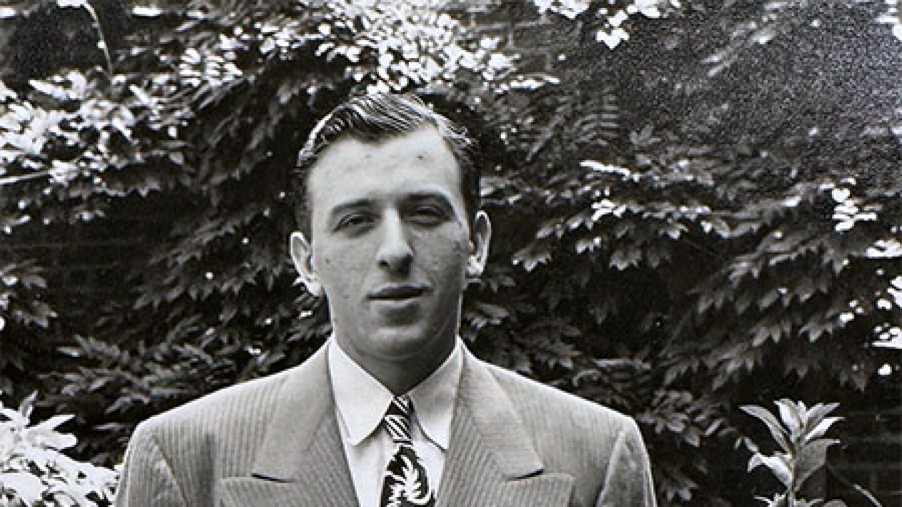
Image: Frank Kameny in 1948. Photo from Library of Congress.
Frank Kameny earned his PhD in astronomy from Harvard in 1956. He studied under the famous Cecilia Payne-Gaposchkin, the stellar astronomer who discovered that the Sun and stars are made of hydrogen.
His PhD was on variable stars, stars that seem to change in brightness with regularity. He took over 500 observations of yellow semiregular variables and RV Tauri stars, two different kinds of variable. He taught for a few years in Georgetown University before being hired in 1957 as an astronomer for the US Army Map Service. Shortly after he started, Kameny’s superiors found out he had been arrested a year prior when he was accused of “lewd and indecent conduct” with another man. In the 50s and 60s, it was common occurrence for the police to arrest members of the same sex dancing, kissing or even holding hands.
His employers suspected him of being gay and he was subsequently fired and banned from any future federal employment.
Sadly, Kameny was not the only person at this time to be fired for being gay. In America, as well as the Red Scare where many suspected communists were investigated and lost their jobs, there was also the “Lavender Scare” where gay and lesbian people were being removed from the government. In less than twenty years, thousands of government employees lost their jobs due to being gay or simply allegations.
Kameny was different though in that he immediately challenged his firing. He first appealed to the District of Colombia. His appeal stated that firing someone for being gay is discriminatory and unreasonable.
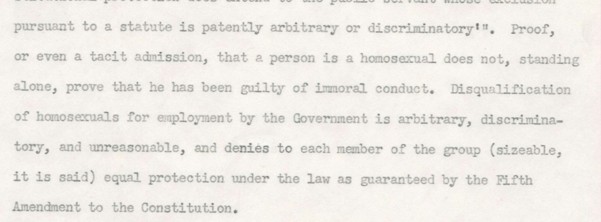
Image: A statement from his appeal from the records of the U.S. Courts of Appeals.
Unfortunately, the court ruled against him. But he kept challenging through various courts leading all the way up to the U.S. Supreme Court. The Supreme Court denied his challenge in 1961.
At this point Kameny was so spurred on by the discrimination and unjust way he was being treated, he turned his attention to activism and co-founded the Mattachine Society of Washington, the first gay rights organization in Washington, D.C. The group would write letters to every government branch. He even wrote to President Kennedy asking him to stop the purging of gay people in government.
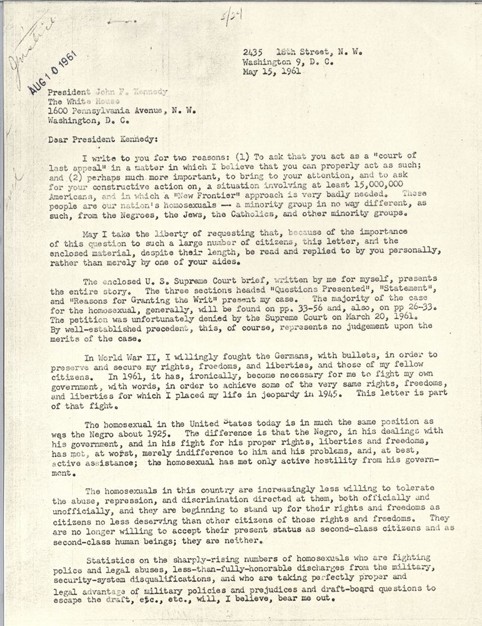
Image: Frank Kameny’s letter to President Kennedy in 1961. John F. Kennedy Presidential Library and Museum
He became one of the leading organizers in the early gay rights movement. Helped organize some of the first gay rights protests in the United States and led demonstrations at the White House, Pentagon, and Civil Service Commission in 1965.
Frank Kameny died in 2011 of heart disease at the age of 86. Even in his final weeks and months he kept a full schedule of public appearances and activism. His last public appearance was 12 days before he died where he gave a speech in Washington D.C to a LGBT group.
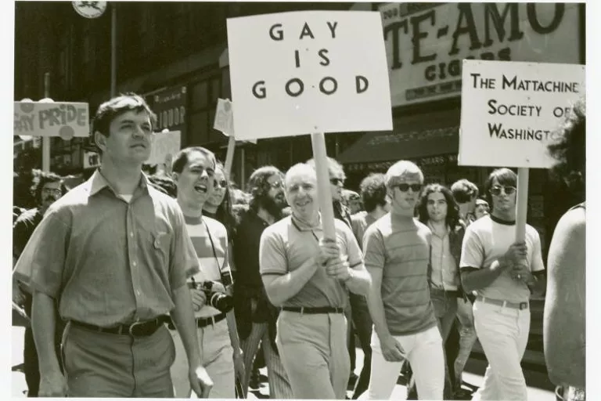
Image: Gay Liberation Day 1970. New York Public Library
Kameny is considered one of the most significant figures in the American gay rights movement. At a time where these mass firings were instigating shame and fear, he defied every expectation. Even though he was denied the opportunity to continue astronomy research, the observations from PhD mark his lasting contribution to the field.
We don’t know what scientific discoveries Kameny might have made had he been allowed to continue his career. His story reminds us that discrimination doesn't just harm individuals, it also deprives science of talented researchers.
Impact of Lavender Scare and how far we’ve come
Kameny’s story isn’t just history. The policies that allowed him to be fired have had a lasting impact on science for decades.
NASA being a government agency, had many employees dismissed for being gay. As the world’s biggest space agency, it is no wonder that there are still so few LGBTQ+ people in the space industry today. Many queer astronomers and scientists did not feel safe to be open about their sexuality or gender. For instance, Sally Ride’s sexuality was not revealed until after she died in 2012.
We’ve come a long way since this time. In the UK being gay is no longer criminalized, and gay marriage has been legal since 2014. Under the 2010 Equality Act there are rights for protected characteristics that it is against the law to discriminate.
LGBTQ+ people can be openly out in a way that would have been impossible at Frank Kameny’s time. And there are many organisations and networks supporting queer scientists.
However, there is still some work to do when it comes to visibility and representation in science. LGBTQ+ people are still underrepresented in STEM fields, are more likely to experience workplace harassment, and often feel pressure to hide aspects of their identity. One study found that more than 40 percent of LGBTQ+ scientists were not out to colleagues or students, even if they were openly out in other parts of their lives.
Going Forward
Making everyone feel welcome and included promotes a nicer workplace environment and is beneficial to scientific research. When someone doesn’t have to spend energy hiding something about their identity, it frees up energy to do actual science!
LGBTQ+-identified people are more likely to be open about their identities if they know their colleagues and employers support them, and if they work in STEM fields with more even representation of men and women.
If you want to know a few organisations that give support to LGBTQ+ people in STEM fields they are linked below.
Conclusion
When Frank Kameny was fired 1957, there were no support networks for LGBTQ+ scientists and no legal protections. Today, astronomy organisations have dedicated committees, mentoring programmes, and advocacy groups. Major agencies and institutions that used to exclude queer people now publicly recognise Pride Month and celebrate the contributions of LGBTQ+ scientists. While there are still some challenges, this is a remarkable change from the world Frank Kameny faced.
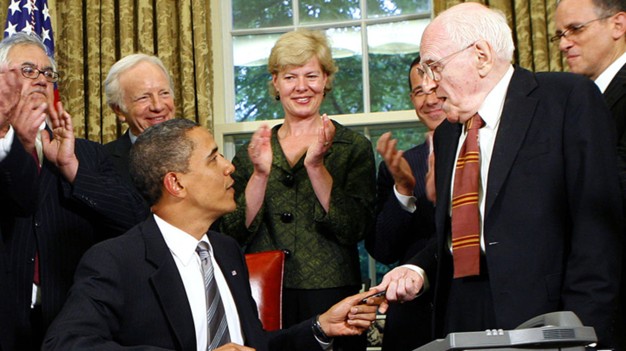
Image: Frank Kameny with Barack Obama in 2009. Pete Souza/The White House.
References:
- Looking through the lens of LGBTQ+ people in science - NCAS
- Pride Pioneer: Frank Kameny and the Early Gay Rights Movement
- Frank Kameny the astronomer - AIP.ORG
- Pride in Pictures before 1970: A radical message that eventually goes mainstream - LGBTQ Nation
LGBTQ+ Organisations:
- Astronomy and Astrophysics Outlist
- 500 Queer Scientists Visibility Campaign : 500 Queer Scientists
- LGBT+ Physical Sciences Network