- You are here:
-
Home

-
News
-
Latest News
- What's Up? July 2026
What's Up? July 2026
July brings the welcome return of darker skies, along with the first Perseid meteors, glowing noctilucent clouds, and the striking Summer Triangle. Stay up late to explore the Milky Way, or rise before dawn to catch Saturn and Mars returning to the night sky. There's plenty to discover as summer stargazing gets into full swing.
What's Up? July 2026
While the nights remain shorter, the darker night skies gradually return as we move into July. They bring with them Summer constellations, the first hints of the Perseid meteor shower and a great pre-dawn planetary display, perfect for clear summer nights.
Highlights
The Perseid Meteor Shower
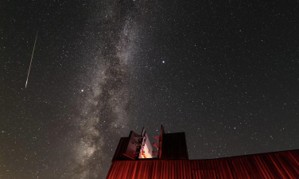
Image Credit: Dan Monk
While the Perseid meteor shower is set to peak in mid-August, these shooting ‘stars’ are expected to be visible from mid-late July, with the number of meteors increasing each night until its peak. This meteor shower is a result of Earth crashing into the tail of dust left behind by Comet Swift-Tuttle, a massive comet that orbits the Sun every 133 years.
Noctilucent Clouds
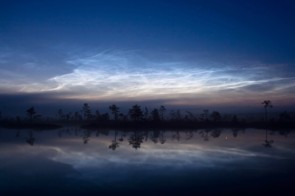
Image Credit: The Planetary Society
Known as ‘night shining’ clouds , these wispy tendrils appear to glow with a frosty blue hue during the Summer months. These clouds are the highest in Earth’s atmosphere, floating near the edge of space where temperatures are coldest during the Summer. This means that ice crystals will condense around tiny dust particles left behind from passing meteors or volcanic eruptions. Because of their extreme altitude, these ice crystals are illuminated by sunlight long after the Sun has set, giving the appearance of a delicate, glowing veil across the evening skies.
Constellations
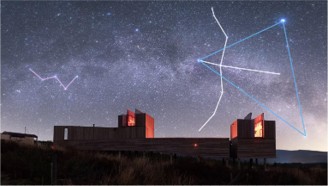
Image Credit: Dan Monk
Image Description: Looking to the East, the Milky Way sits above the Observatory. The pink ‘W’ highlights Cassiopeia. Shown in white is Cygnus, the Swan. The blue triangle represents the Summer Triangle.
July’s light and moonfilled nights can make the starry, nebulous band of the Milky Way difficult to make out as it stretches across the sky. Along the pale, dusty river however sits two prominent constellations made up of bright, easily-visible stars, Cassiopeia and Cygnus, and one (literally) star-studded asterism: The Summer Triangle.
Cassiopeia
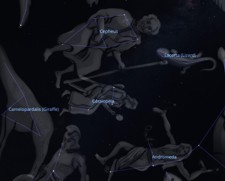
Image Credit: Stellarium
In Greek Mythology, Cassiopeia was the Queen of Ethiopia. Her Husband, King Cepheus, and Daughter, Andromeda, sit close by to her in the night sky. As one of the closest constellations to Polaris, the North Star, Cassiopeia is visible from the Northern Hemisphere all year round, and its distinct zig-zag-like “W” or “M” shape makes it easy to spot. She sits atop the Milky Way and, by lining her up with Cygnus, can be used to help locate the dark dust lanes and dense star clouds of our home galaxy.
Cygnus and The Summer Triangle
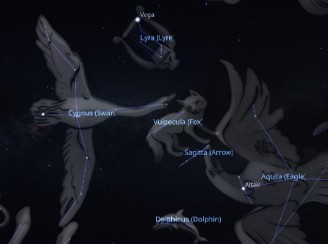
Image Credit: Stellarium
The constellation Cygnus depicts a celestial swan, stretching its wings out as it appears to nose-dive into the plane of the Milky Way, towards our Galactic Core. By following the central line, or body, of Cygnus towards the South you will be guided towards the Galactic Center of the Milky Way. This is the densest, and therefore brightest, region of the Milky Way visible from the UK, and late Summer is a great time to view it. Alternatively, following Cygnus’ path towards the North will lead you to Cassiopeia.
The brightest star of the Cygnus is Deneb, the so-called ‘tail star’ of the Swan. Together with Vega and Altair, the brightest stars within the constellations Lyra and Aquila respectively, these three stars form the Summer Triangle, which will sit high overhead from mid-summer through to early autumn.
The ‘eye’ of the swan is Alberio, a double star which can be easily resolved through a pair of binoculars. It is well known for its starkly contrasting components; Alberio A is an orange giant five times larger than our Sun and appears golden-yellow, while Alberio B is a hotter, smaller star appearing blue-white.
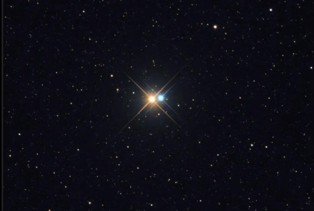
Image Credit: Kfir Simon via Tivoli Astro Farm
Scorpius
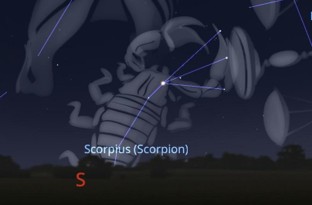
Image Credit: Stellarium
If we turn around to look towards the southern sky, we can see some of our seasonal constellations. Reaching its highest point in Mid-July, we can catch a glimpse of Scorpius, best viewed in the hours following sunset. Its highest point, however, is still relatively low so you will need an obstructed southern view. Scorpius is easily identifiable by Antares, one of the largest stars visible to the naked eye representing the ‘heart’ of the scorpion. A gargantuan red supergiant some 800 times larger in size than our own Sun, thanks to its luminosity and fiery-red colour, Antares is often mistaken for the planet Mars.
Planets and the Moon
Planets
July signals a summer’s goodbye to Jupiter, who sets below the western horizon shortly after sunset. Trailing behind is Venus, who will remain visible in the late-evenings throughout the month, albeit hugging the horizon tightly which can make it difficult to observe.
Instead, it is the (very) early birds amongst us that will be best set to see some of our solar-system neighbours this month. Saturn will return to our night skies, beginning to make its ascension in the East from around 1am at the beginning of the month. Over the course of July Saturn will rise earlier and earlier, and will be visible in the night sky before midnight by the end of the month.
Just a few hours behind Saturn is Mars. At the beginning of the month, Mars will rise in conjunction with Uranus in the pre-dawn skies. By the end of July, it will sit nicely above the horizon after 2am.
The Moon
Following a Full Moon at the end of June, the first two weeks of July will allow us to observe a Waning Moon, before arriving at a New Moon on the 14th which will provide a great opportunity for some dark-sky observing. We’ll then watch the Moon wax to become fully-illuminated ‘Buck’ Moon on the 29th, traditionally denoting the time of year when male deer begin to grow their velvety antlers.