- You are here:
-
Home

-
News
-
Latest News
- What’s Up? June 2026
What’s Up? June 2026
Summer is officially here, and while the nights may be shorter, June’s skies still have plenty to offer. From the bright stars of the Summer Triangle and glowing Arcturus to the stunning Whirlpool Galaxy and the year’s longest day, there’s lots to discover under the twilight skies.
What’s Up June 2026
Summer is officially here! We’ve had some lovely warm weather towards the end of May, and hopefully June will continue to bring us clear skies. Although we’ll be losing a lot of darkness, there is still plenty to observe at this time of year.
Constellations
The spring constellations are on their way out and our summer constellations are starting to take more prominence in the skies.
The suitably named Summer Triangle will be nice and high in the sky, making it an easy one to spot. It contains three of the brightest stars – Vega, Altair and Deneb.
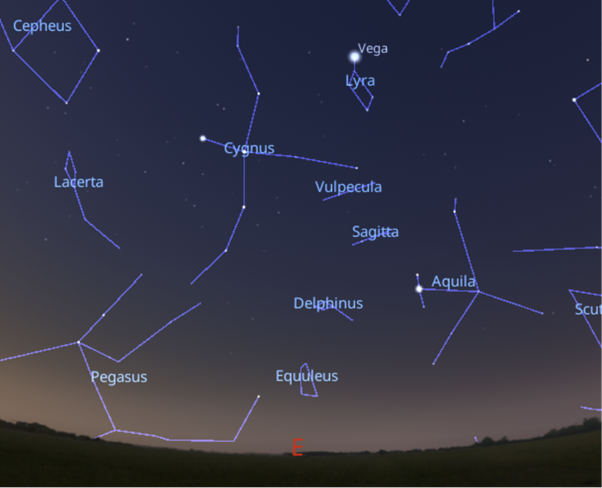
The summer triangle is shown in red. Credit: Stellarium
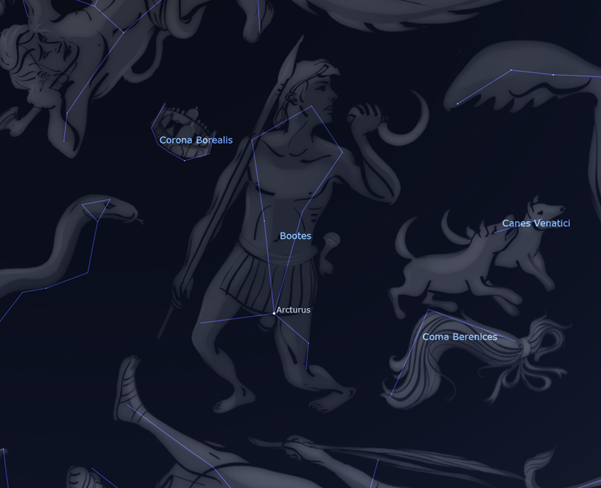
BoötesCredit: Stellarium
Another headliner in our summer skies is the constellation of Boötes. Exactly who the Boötes myth is meant to represent is a little bit murky, however it roughly translates to “herdsmen”. It’s a fairly large constellation but it doesn’t have too many prominent objects in it aside from the bright star Arcturus. Arcturus is a bright red giant 37 light years away from earth. It is actually the brightest star in our summer skies here in the UK, and the 4th brightest overall. It glows a warm amber, due to the cool surface of the star (4000 degrees celsius).
Object of the month - The Whirlpool Galaxy
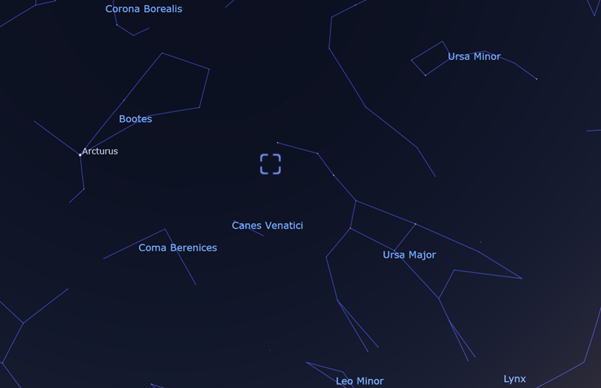
Where to find the Whirlpool galaxy – near the tail of Ursa Major, the Great Bear. Credit: Stellarium
Although the nights will be very light, if you have a small telescope you should still be able to see some deep sky objects. The object of the month for June is The Whirlpool Galaxy or M51.
The Whirlpool Galaxy can be found close to Ursa Major. It is around 24 million light years away, and is one of the best examples of an interacting galaxy in our night sky. The galaxy is face on so we can see it’s beautiful spiral structure which it is named for, those long spiral arms are long lanes of stars and gas. It is interacting with NGC 5195, a dwarf galaxy that has been caught in M51’s gravitational pull.
This pull from the dwarf galaxy is thought to be the reason M51’s spiral arms are so long and prominent.
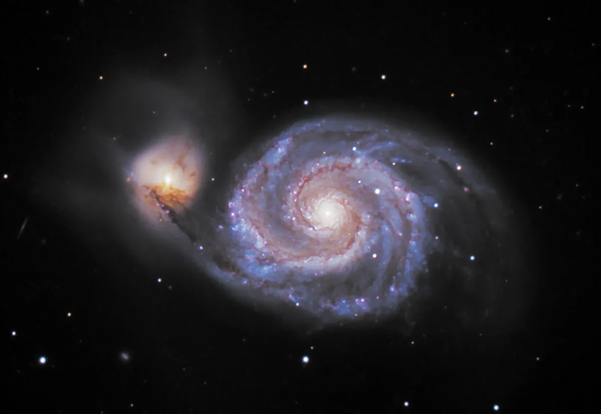
The Whirlpool galaxy. Credit: Steve Porter, Bardsey Island, North Wales, UK. Equipment: Meade 10" LX 200 ACF, EOS 6.
The Summer Solstice
June 21st marks the longest day of the year! Where in the UK we will be getting a whopping 17 hours of daylight. Astronomers get very excited on this date because finally the skies start getting darker again!
Many cultures around the world mark this day by celebrating with family, friends, playing music and eating special foods.

Summer solstice at Stonehenge. Credit: BBC
Planets
June will probably be the last month you will see Jupiter until winter comes back around, so make sure to catch it before it goes! Mercury and Venus will be visible shortly after sunset, though very low down in the sky. On June 15th Mercury will be at it’s greatest eastern elongation, meaning this is the best time to try and spot it. It will be very close to the horizon towards the northwest as the sun is setting.
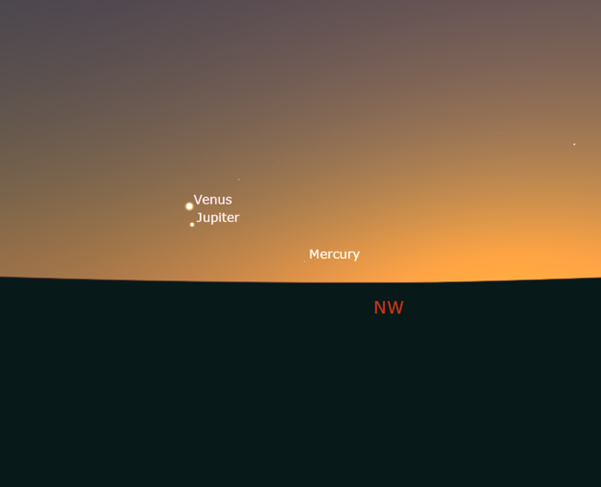
10th June at 22:47. Venus, Jupiter and Mercury all close together near the western horizon just after the Sun sets. Credit: Stellarium
Moon Phases
Last Quarter: June 8
New Moon: June 14
First Quarter: June 21
Full Moon: June 29
Happy Stargazing!