- You are here:
-
Home

-
News
-
Latest News
- What's Up? May 2026
What's Up? May 2026
May is a month of transition, as spring skies give way to summer. Spot the bright stars Vega and Deneb returning, discover the stunning Hercules Cluster (M13), and enjoy rare lunar highlights... including a Blue Moon and delicate Earthshine.
There’s plenty to explore as the nights grow shorter.
Constellations
May is a transition month, with spring constellations giving way to summer ones: the appearance of the two bright stars Deneb and Vega signals to astronomers the approach of summer.
Follow these 2 bright stars and you will find to their right the distinctive shape of Hercules. Vega and Deneb will appear about 1 hour after sunset, but Hercules will be best visible if you wait for the night to grow a bit darker: in May, that means waiting for 11PM.
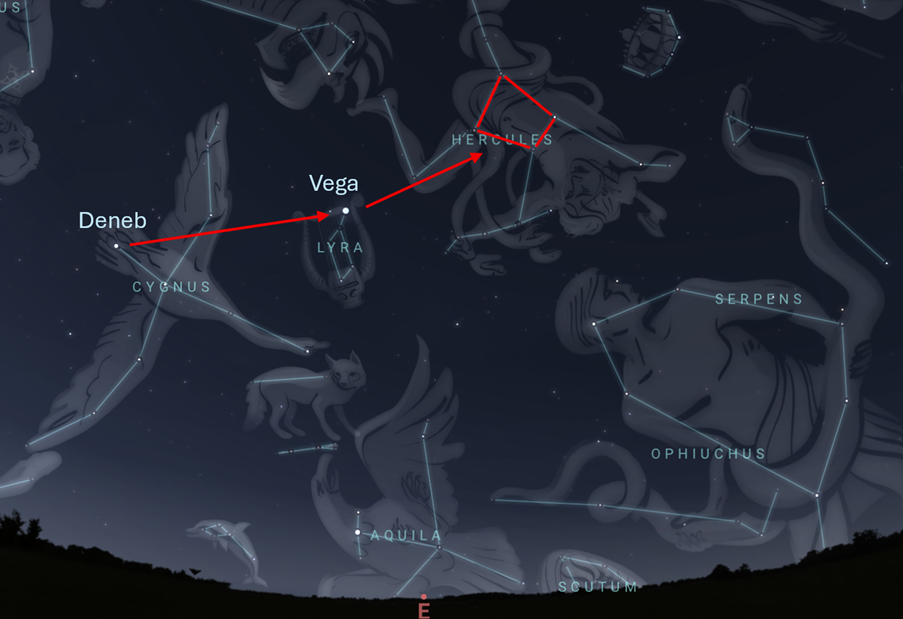
Finding Hercules from Cygnus and Lyra by following the stars Deneb and Vega.
Simulated sky above Kielder Observatory on May 15 at 2315. Credit: Stellarium
Object of the month
Hercules is host to one of the finest clusters of stars in the sky: M13, aka the Great Hercules Cluster. To find it, follow a line between the two top stars of the square of Hercules: M13 is situated about one third of the way down.
The Hercules Cluster is a vast spherical swarm of hundreds of thousands of ancient stars, located about 22,000 light-years away in the constellation of Hercules. Visible as a fuzzy mass of stars through a pair of binoculars, even a small telescope reveals it as a sparkling cluster, making it one of the most impressive deep-sky sights in the Northern Hemisphere. At over 11 billion years old, it offers a glimpse into the early history of our galaxy.
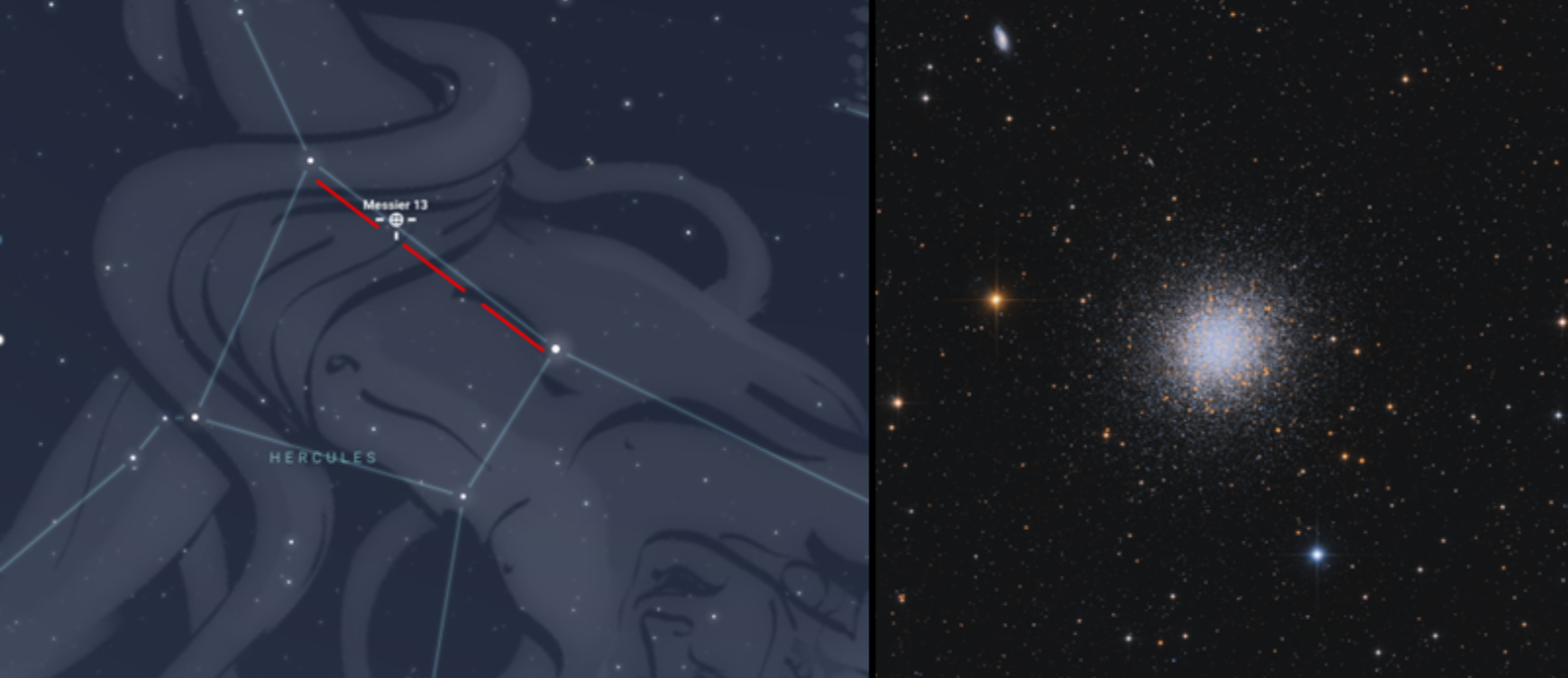
Left: Finding the Hercules cluster in the constellation of Hercules. Credit: Stellarium
Right: the M13 cluster as imaged through an amateur telescope.
The Moon
Full Moon: 1st
Last Quarter: 9th
New Moon: 16th
First Quarter: 23rd
Full (Blue) Moon: 31st
The full Moon on May 1st is known as the Flower Moon, named after the abundance of spring blooms. With two full Moons this month, the second (31st) is also considered a Blue Moon.
On May 19th, a very thin crescent Moon will sit between Jupiter and Venus in the evening sky. Although also technically visible, it will be rather difficult to spot Mercury.
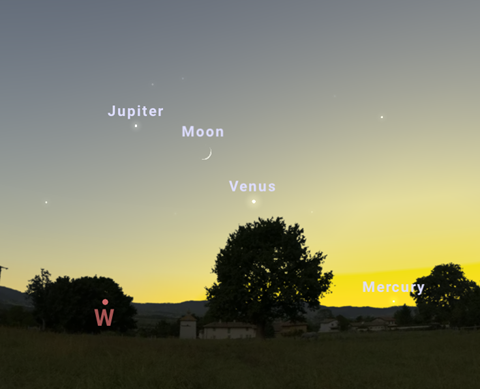
The thin crescent Moon between Jupiter and Venus. Simulated sky above Kielder Observatory on May 19 at 2215. Credit: Stellarium
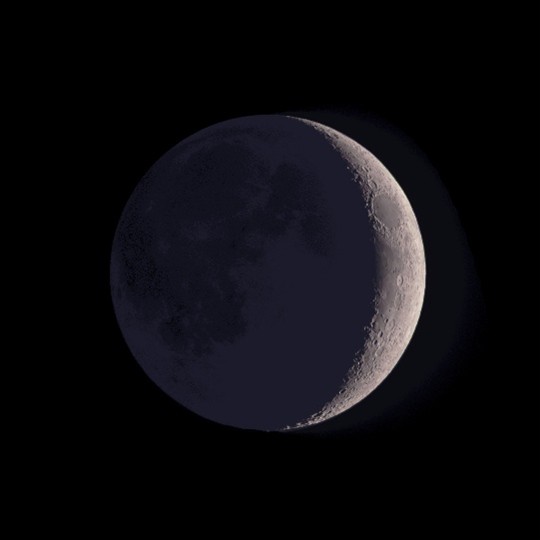
A very beautiful phenomenon will also be visible on this night: the Earthshine. While the bright crescent is lit directly by the Sun, the rest of the Moon’s surface will also glow, albeit much more faintly, due to sunlight reflected off the Earth’s surface: a subtle effect known as Earthshine, depicted on the diagram below.
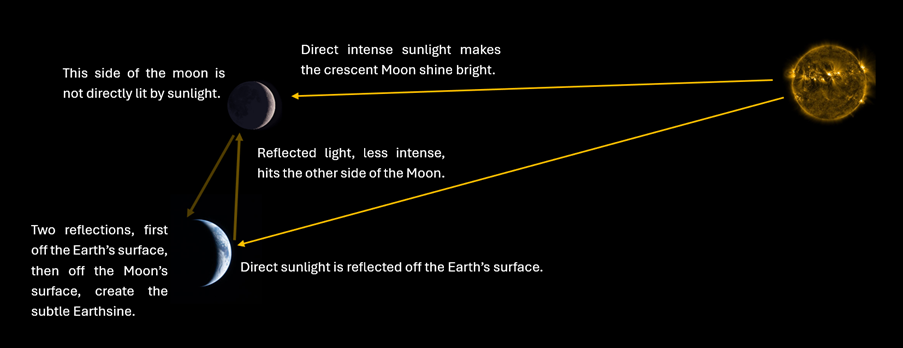
Although this happens every month when the angle between the Sun, the Earth and the Moon is just right (a few days after the new Moon), it is often missed by observers, as it requires careful observation to spot. A pair of binoculars will help you gather more light than the unaided eye can capture, and will reveal some of the hidden features on the fainter side of the Moon.