- You are here:
-
Home

-
News
-
Latest News
- What's Up? April 2026
What's Up? April 2026
Spring has sprung, and April’s skies are full of seasonal highlights. From bright Venus glowing at sunset to Jupiter shining in Gemini, there’s plenty to spot — including a beautiful Moon-planet alignment on the 23rd. Add in the Lyrid meteor shower and the rising constellation Lyra, and April offers a perfect mix of stargazing treats.
What’s up April 2026
Spring has sprung!
Planets
Mercury, Mars, Saturn and Neptune have passed behind the Sun and are slowly making their way back into the morning sky, but they will be extremely hard to spot as they are so low on the horizon before Sunrise-but get excited for their return in Autumn.
What will be a good planet spot is Venus, just as the Sun sets Venus can be seen bright in the twilight sky.
Jupiter is high and mighty still in the constellation of Gemini, making a nice bright triangle of dots with the stars Castor and Pollux, the heads of the twins. Even a small telescope or a pair of binoculars will get you seeing the 4 Galilean moons lined up around this Planet. Venus Jupiter and the Moon will be in a nice line at sunset on the 23rd.
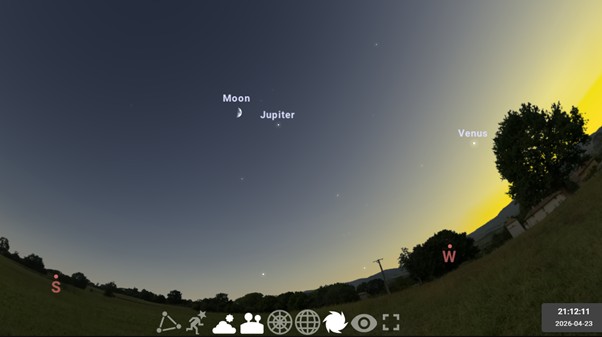
Figure 1: April 23rd alignment of Jupiter and Venus and Half Moon.
Uranus is a harder and not always rewarding spot. In the constellation of Taurus, just under and west of the Pleiades cluster, a small blue iridescent dot is visible, less twinkly than a star, but not visible to the naked eye. Assistance with a telescope or binoculars will be required. This is the last good month for finding this planet before the later sunsets obscure it in the sky. On the 19th we have a lovely conjunction of the crescent moon and Venus sandwiching the Pleiades cluster, or the “heart of the Bull” of the constellation of Taurus in the western sky.
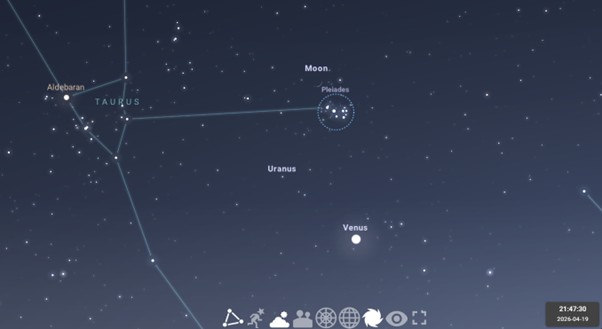
Figure 2: April 19th congregation of the crescent moon, Uranus and Venus in the constellation of Taurus.
Meteor shower
From the 14th -30th, Peaking on the 22nd of April the Lyrid meteor shower will be happening. One of the oldest known showers, with records dating back 2600 years is it a modest shower of around 20 meteors per hour during its peak. It is best viewed in the pre-dawn sky.
Constellations
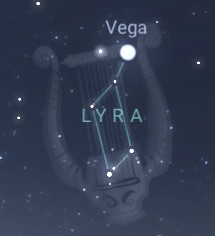
Figure 3: Lyra outline and artistic interpretation of the Lyre. Credit: Stellarium.org
Let’s have a look this month at Lyra, since we need to find it to see where the Lyrid meteor shower shoots out from (so pro-tip, turn your back to it to see the longest streaks of light from the shooting stars going across the sky above you). Rising in the East Lyra’s most distinctive star is Vega, the third brightest star we see in the Northern Hemisphere, fifth brightest overall if we include the southern sky too. Through a telescope, as this star rises it looks like a sparkling blue diamond. It loses its twinkle as it gets so high the atmosphere doesn’t affect our view of it as much but still a very bright star. The rest of the constellation is made up of a diamond shape of 4 stars below Vega. This makes the shape of the ancient instrument the lyre. Apparently.
Along with Vega the slightly dimmer star Deneb, the tail feather of Cygnus the swan and the star Altair, the crest of the Eagle makes up the Summer triangle which is a large very prominent triangle that hails the return of Summer nights.
Moon Phases:
2nd: Full moon
10th: Half moon
17th: New moon
24th: Half moon
The full moon this month is known as the Pink moon, named after the pink wildflower “pink moss” (Phlox Subulata) that blooms in spring. It also the Paschal Full moon, the first full moon after the spring equinox which heralds Jewish Passover and the following Sunday after this full moon is Easter.
Clears Skies and Happy Stargazing!