- You are here:
-
Home

-
News
-
Latest News
- A century of liquid rocket propulsion
A century of liquid rocket propulsion
In March 1926, physicist Robert H. Goddard launched the world’s first successful liquid-fuelled rocket, a brief flight that would ignite a revolution in spaceflight. A century later, the same propulsion concept powers everything from the mighty Saturn V that carried astronauts to the Moon during the Apollo 11 Moon Landing to the reusable rockets of companies like SpaceX.
In this article, Kielder Observatory astronomer Grégoire Mahaut explores how one small rocket launch helped shape a century of innovation, and why liquid propulsion still drives the modern Space Age!
A century of liquid rocket propulsion:
from Robert H. Goddard to the modern Space Age
On a cold day in March 1926, a small experimental rocket rose briefly from a snowy field in Auburn, Massachusetts. The flight lasted only a few seconds and reached a height of just over 12meters. Yet that short ascent would go down in history: this rocket was the world’s first successful liquid-fuelled rocket, designed and launched by American physicist and engineer Robert H. Goddard.
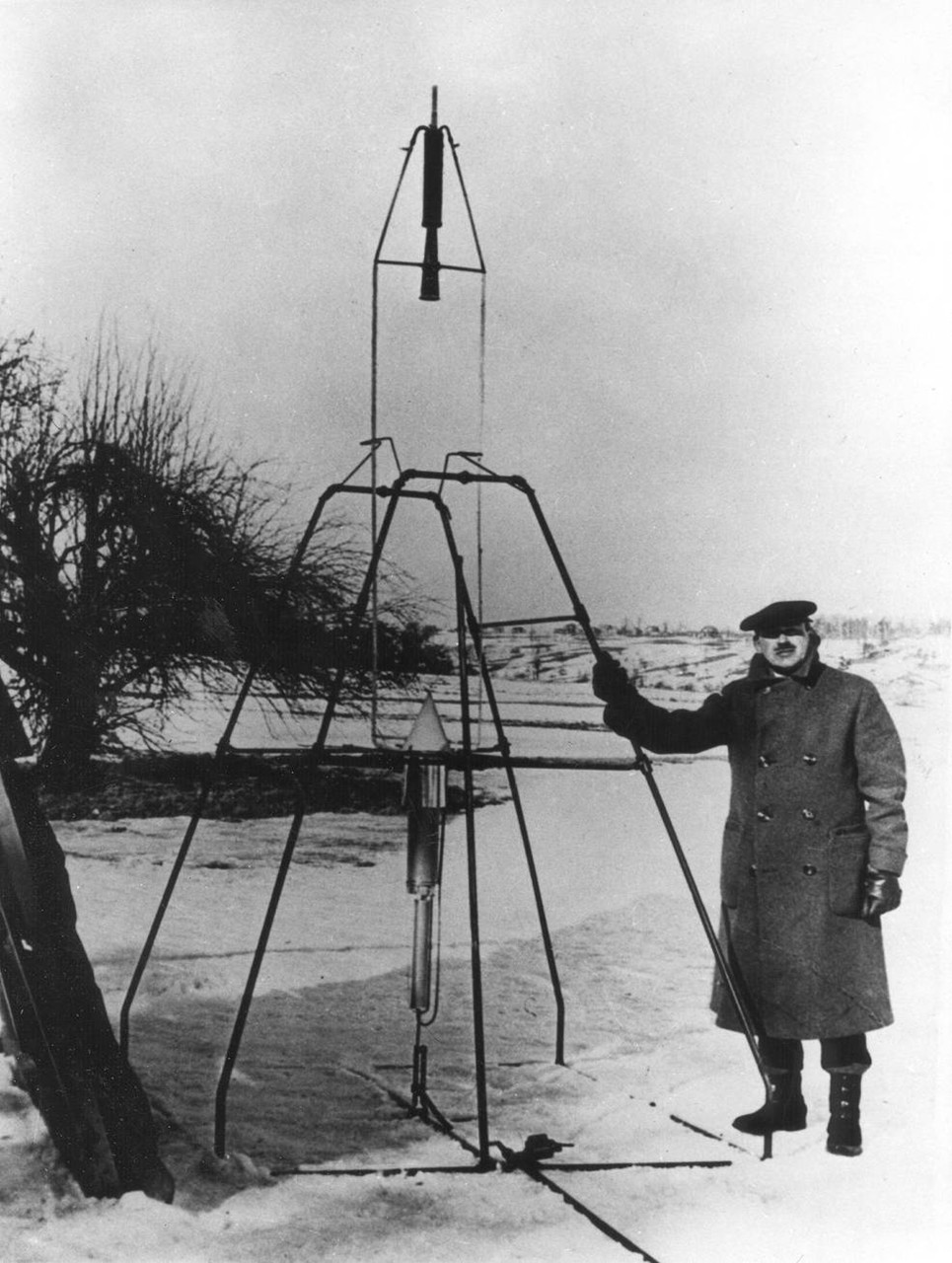
Robert H. Goddard posing next to his rocket prior to its maiden flight. Credit: U.S. Air Force
A century later, nearly every major launch vehicle used for space exploration relies on the same propulsion concept Goddard demonstrated that day: liquid propellants mixed and burned inside a controlled rocket engine. From early experimental rockets to powerful engines capable of sending humans to the Moon and robotic spacecraft across the solar system, liquid propulsion has shaped the modern era of spaceflight.
________________________________________
Goddard’s early dreams of space travel
At the beginning of the 20th century, rockets were largely seen as curiosities or military fireworks rather than serious scientific tools. Most rockets used solid propellants, packed mixtures of fuel and oxidizer, often similar to or derived from gunpowder. While these rockets were simple and reliable, they had serious limitations: once ignited, they burned uncontrollably until the fuel was gone with very little ability to regulate thrust or shut down the engine.
Goddard believed rockets could be far more controllable. Inspired by physics and mathematics, he recognised that rockets could operate efficiently in the vacuum of space and might one day carry instruments, or even people, beyond Earth. His early research explored ways to improve rocket efficiency, stability, and propulsion.
In 1919, Goddard published a groundbreaking report titled A Method of Reaching Extreme Altitudes. In it, he proposed rockets capable of reaching the upper atmosphere and suggested that such vehicles could eventually travel to the Moon. Although the idea captured public imagination, many critics and fellow physicists dismissed it as unrealistic.
But this did little to weaken Goddard’s determination. He continued his research despite criticism, brushing aside sceptics with a now-famous remark: “Every vision is a joke until the first man accomplishes it; once realized, it becomes commonplace.”
________________________________________
The first liquid rocket
After years of experimentation, Goddard built a small test rocket powered by liquid oxygen and gasoline. Unlike solid rockets, the propellants were stored separately and fed into the engine where they mixed and ignited.
On March 16, 1926, exactly 100 years ago, Goddard conducted his historic launch. The rocket lifted off, reached a top altitude of 41 feet (12.5m) and remained airborne for roughly 2.5 seconds before landing in a nearby cabbage field, after having travelled about 184 feet (56m).
Although modest in scale, the experiment proved several revolutionary ideas:
• Liquid propellants could generate reliable thrust
• Rocket engines could be controlled and throttled
• Liquid propulsion could potentially produce much more powerful rockets
The success marked the birth of modern rocket engineering.
________________________________________
Innovations beyond the first launch
Goddard’s achievements did not stop with the first liquid rocket. Over the following decade, he continued refining rocket technology through a series of experiments, primarily in remote testing locations.
Working with financial support from institutions including the Smithsonian Institution, Goddard developed many technologies that remain fundamental to rocket design today:
• Gyroscopic guidance systems to stabilise rockets in flight
• Steerable nozzles and vanes for directional control
• Fuel pumps and injectors to deliver propellants efficiently
• Lightweight structural designs for improved performance
These innovations transformed rockets from unstable experimental devices into controlled vehicles capable of reaching significant altitudes.
Despite these breakthroughs, Goddard’s work remained relatively obscure during his lifetime. Rocket research in the United States received limited attention compared to similar developments elsewhere.
________________________________________
The global expansion of rocketry
While Goddard continued refining liquid propulsion in the United States, engineers in Europe began exploring similar ideas during the 1930s and 1940s.
One notable result was the development of the V-2 rocket, the first long-range guided ballistic missile. Although built for military purposes, the V-2 demonstrated the immense potential of liquid rocket propulsion. After World War II, knowledge gained from these rockets helped shape early space programs.
In the United States, engineers such as Wernher von Braun became central figures in developing large launch vehicles. Many of the technologies they used, including turbopumps, controllable fuel injection systems, and nozzle designs; were built upon principles pioneered by Goddard several decades earlier.
________________________________________
Liquid propulsion and the Space Race
The mid-20th century saw rockets evolve from experimental machines into powerful launch vehicles capable of reaching orbit. Liquid propulsion was essential to this transformation.
In 1957, the Soviet Union launched the world’s first artificial satellite during the Sputnik 1 launch. This event triggered the intense technological competition known as the Space Race.
Both the Soviet Union and the USA relied heavily on liquid-fuelled rockets to achieve their goals. These engines allowed engineers to precisely control thrust and stage multiple rockets together, dramatically increasing payload capacity.
The culmination of this era came in 1969, when NASA’s massive Saturn V rocket carried astronauts to the Moon during the Apollo 11 Moon Landing mission. The rocket’s powerful engines burned liquid hydrogen and liquid oxygen, producing millions of pounds of thrust.
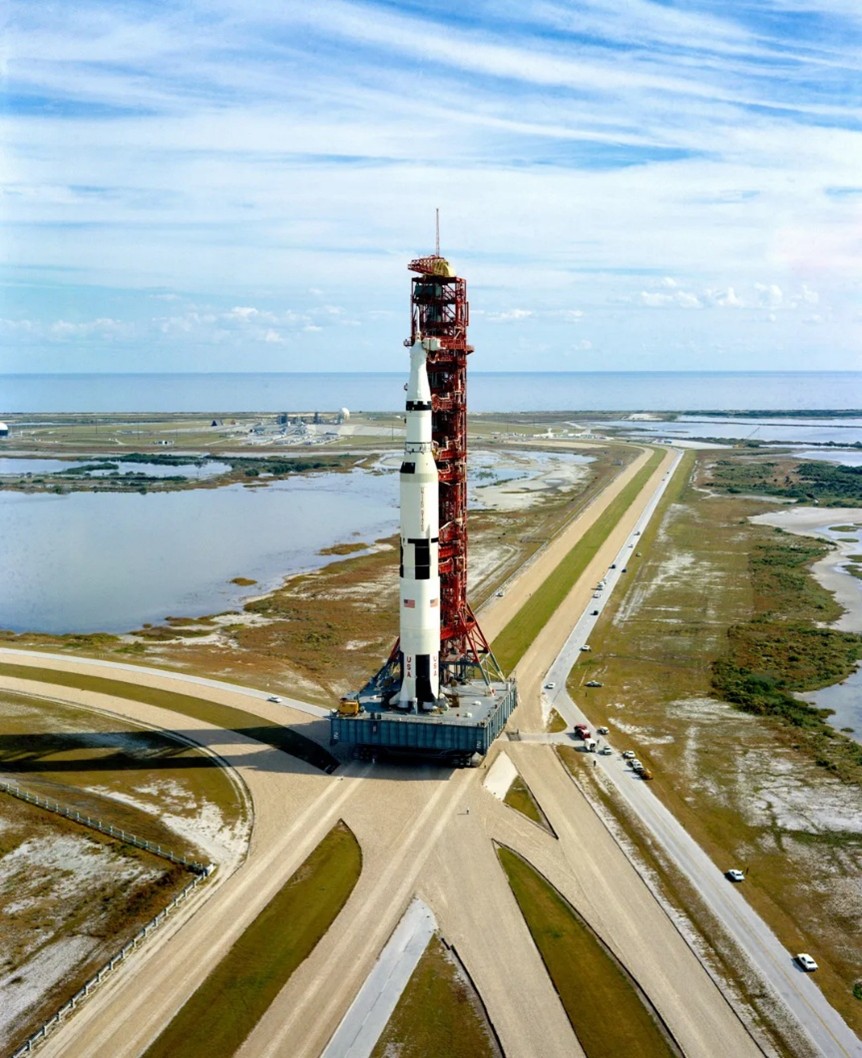
Saturn V rocket: to give you an idea of the scale diference, try to spot the human being near the near right corner of the platform!Goddard first rocket reached an altitude roughly as high as the blue platform under the rocket.
Though vastly more advanced (and around half a million times heavier), than Goddard’s early prototype, the Saturn V rocket followed the same fundamental concept: liquid fuels burned in a controlled combustion chamber to generate thrust.
________________________________________
The technology of liquid rocket engines in the Modern Era
Modern liquid rocket engines are complex machines, but their underlying principle remains elegantly simple. A liquid fuel (such as liquid hydrogen) and an oxidizer (such as liquid oxygen) are stored in separate tanks. Pumps force them into a combustion chamber, where they mix and ignite. The resulting high-temperature gases (mainly water vapour) expand through a nozzle, producing thrust according to Newton’s laws of motion.
Liquid propulsion offers several advantages:
Control and Throttling
Engineers can adjust the flow of propellant to increase or decrease thrust during flight.
High Efficiency
Many liquid propellant combinations provide greater energy than solid fuels.
Restart Capability
Some liquid engines can shut down and restart, enabling precise orbital manoeuvres.
Because of these benefits, liquid propulsion is used in many of the most powerful rocket engines ever built.
Today, liquid propulsion remains central to both government and commercial spaceflight. Organisations like ESA, NASA and private companies such as SpaceX continue to refine and expand rocket technology.
Modern launch vehicles use advanced liquid engines capable of producing enormous thrust while maintaining high efficiency. Some are even designed to be reusable, landing back on Earth after delivering payloads to space.
New propellant combinations and engine cycles are also being explored, improving performance and reducing costs. Yet despite these innovations, the core concept demonstrated by Goddard a century ago remains unchanged.
________________________________________
Goddard’s lasting legacy
During his lifetime, Goddard received more than 200 patents related to rocket technology. Many of his ideas were decades ahead of their time, and several were later incorporated into large launch systems used during the Space Race.
Today he is widely recognised as one of the founding figures of modern astronautics. NASA even named its primary rocket research facility in his honour: the NASA Goddard Space Flight Center.
A hundred years after the first liquid rocket flight, humanity routinely launches satellites, probes, and astronauts into space. Missions explore Mars, observe distant galaxies, and study the origins of the universe.
All of these achievements trace part of their technological heritage back to a modest experiment in a Massachusetts field.
What began as a brief flight lasting just seconds helped ignite a century of innovation, one that continues to this day to propel humanity farther into space.
Grégoire Mahaut, Aeronautical Engineering MSc, Astronomer at Kielder Observatory