- You are here:
-
Home

-
News
-
Latest News
- What's Up? March 2026
What's Up March 2026
Constellations
Winter melts into the spring sky and we enjoy the best of both seasons’ offerings. We can still behold the bright stars that comprise the Winter Triangle asterism: Sirius (Canis Major), Procyon (Canis Minor) and Betelgeuse (Orion), and the constellation Boötes is now high enough to appreciate the star Arcturus. At 37 light years away, the red giant Arcturus appears as the second brightest star in the March sky, outshined only by Sirius. To find Arcturus, follow the curve of Ursa major’s tail, Alioth, Mizar, and Alkaid until the next brightest star.
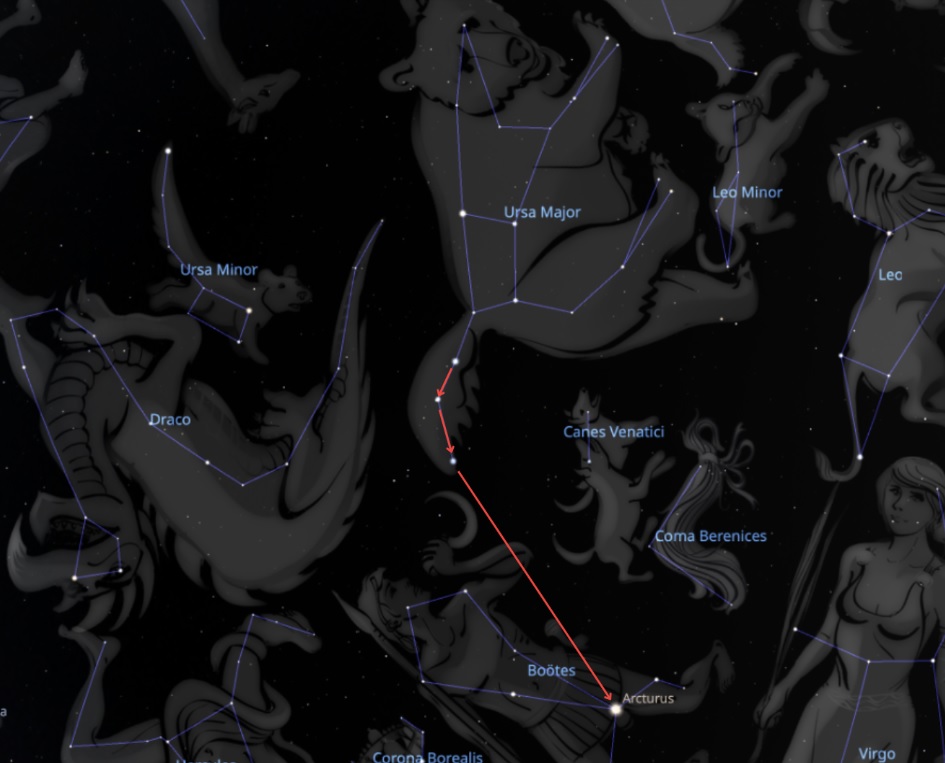
Finding Arcturus from Ursa Major by following the curve of the stars Alioth, Mizar, and Alkaid.
Simulated sky above Kielder Observatory on 15 March at 2200. Credit: Stellarium
Object of the Month
Happy galaxy season! From March to May, astronomers point our telescopes to the emerging constellations Leo, Coma Berenices, and Virgo where we find some of the most rewarding galaxies. Though they often require more powerful telescopes than just binoculars – and still may just appear as smudges – the challenge is all part of the fun!
To usher us into galaxy season, our object of this month is the pinwheel galaxy.
The Pinwheel Galaxy gives us a head-on view of the spiral galaxy. Located 25 million light years away, the galaxy stretches 170,000 light years across (twice the diameter of the Milky Way) and contains about 1 trillion stars. Young, hot stars glow blue in the galaxy’s spiral arms.
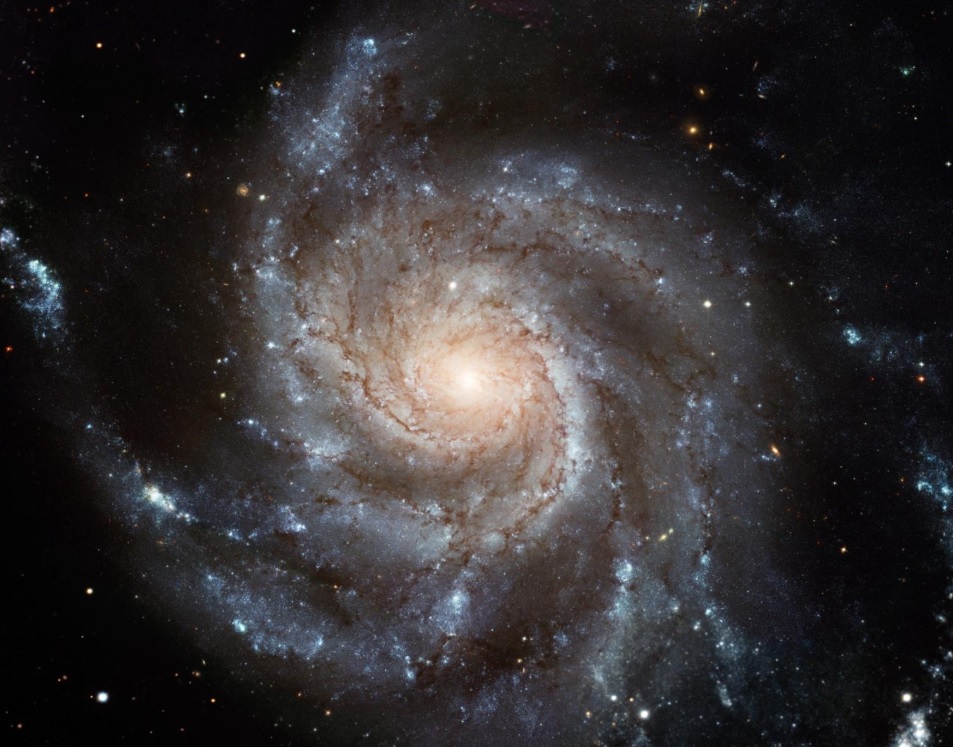
Hubble image of the pinwheel galaxy. Credit: NASA, ESA, K. Kuntz (JHU), F. Bresolin (University of Hawaii), J. Trauger (Jet Propulsion Lab), J. Mould (NOAO), Y.-H. Chu (University of Illinois, Urbana) and STScI; CFHT Image: Canada-France-Hawaii Telescope/J.-C. Cuillandre/Coelum; NOAO Image: G. Jacoby, B. Bohannan, M. Hanna/NOAO/AURA/NSF
M101 - Pinwheel Galaxy (NGC 5457) possible to spot with 10x50 binoculars in a dark sky. Located in Ursa Major, the Pinwheel Galaxy is highest in the sky though the spring. You can find it by creating an imaginary equilateral triangle above the two last stars in Ursa Major’s tail, Alkaid and Mizar.
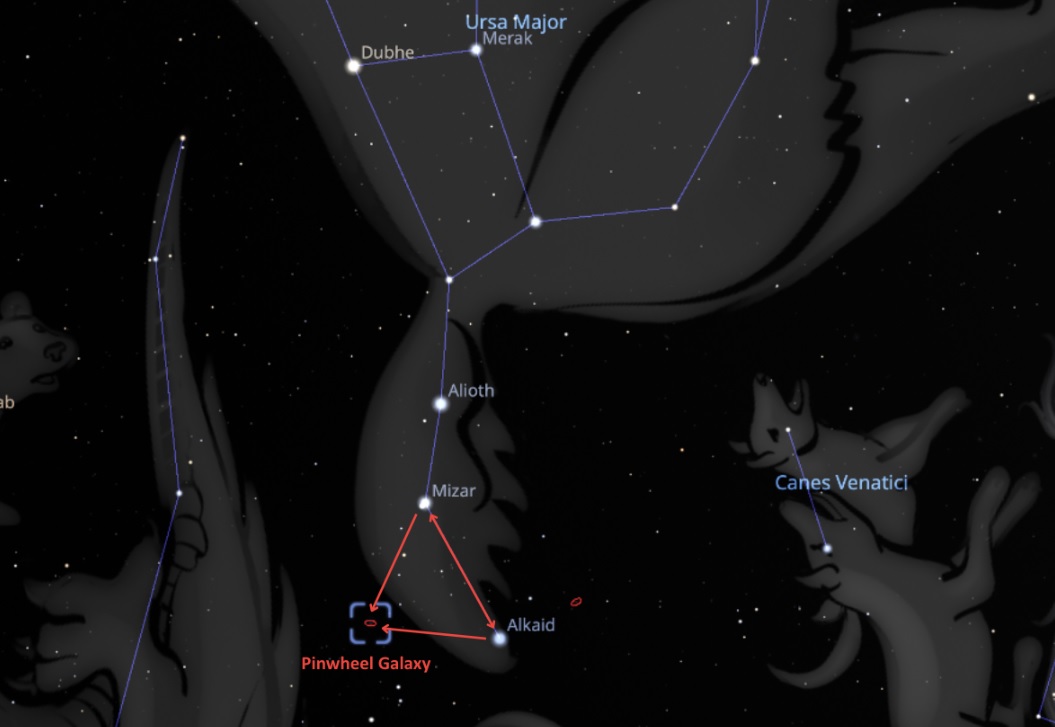
Find the Pinwheel Galaxy (M101) by making an equilateral triangle above Ursa Major’s tail using the stars Mizar and Alkaid. Credit: Stellarium.
Planets
Jupiter still shining in Gemini as the second brightest object in the sky, after to the moon.
Venus visible in the early evening sky just off the western horizon, following closely behind the sun.
On 8 March, there will be a Venus-Saturn conjunction where the two planets will appear close together in the sky, withing 1 degree of separation or roughly the width of a thumb held at arm’s length. The occurs just around sunset for us in the UK.
Following the conjunction, Saturn will sink below the horizon until 12 April, when it will appear in the morning sky.
The Moon
Full Moon: 3 March
Last Quarter: 10 March
New Moon: 18 March
First Quarter: 25 March
The 3 March full moon, dubbed the worm moon, is also a lunar eclipse visible for North America, Australia, New Zealand, East Asia, and the Pacific. About 31% of the world’s population can enjoy this astronomical event.
The eclipse will take place between 0844-1422 GMT. The moon will ambré into an orange glow during the penumbral phase as it positions behind Earth. At totality, between 1104-1202 GMT (peaking at 1133 GMT) the moon will glow red. After the 58-minute totality, the moon will recede back to its regular colouring.
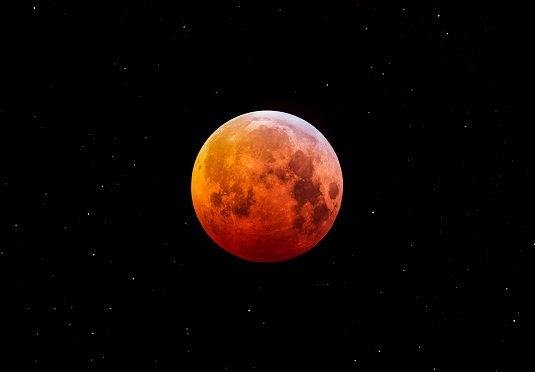
Image of the 21st January 2019 lunar eclipse taken from Kielder Observatory.
This image is sold as a print in the Kielder Observatory Gift Shop! Credit: Dan Monk
Lunar eclipses occur when the moon aligns directly opposite the sun from Earth. Sunlight, which would otherwise shine directly on the moon’s face, passes through Earth’s atmosphere. Though sunlight appears white, it consists of a spectrum of colours that diffract in the differently in the atmosphere. The shorter blue wavelengths of light scatter away and the longer yellow, orange, and red wavelengths of light pass through the atmosphere to shine on the moon – making the moon appear a rusty orange-red.
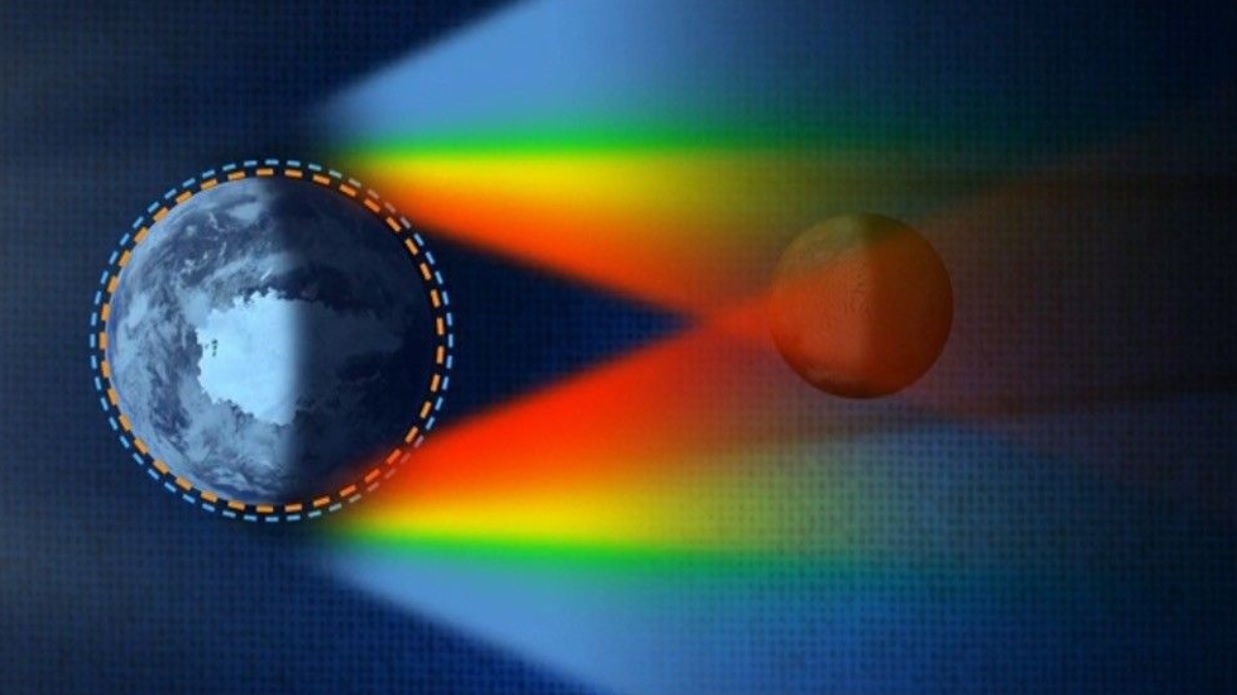
Light passing through Earth’s atmosphere casts the moon in a red shadow during a lunar eclipse.
Credit: NASA Goddard Space Flight Center/Scientific Visualization Studio
The lunar eclipse is safe to view with the naked eye, unlike solar eclipses. The eclipse also does not require binoculars or telescopes to appreciate.