- You are here:
-
Home

-
News
-
Latest News
- What's Up? January 2026
What's Up? January 2026
January’s long, dark nights are perfect for stargazing. From the story of Gemini the Twins and a New Year meteor shower to Jupiter at its brightest, rare planet groupings, and beautiful Moon encounters, the winter sky is full of wonders waiting to be explored.
New Year, new skies! Discover what wonders await in January’s night sky.
What’s up January 2026
January Skies bring long nights, with the sun setting by 4pm most of the month. Perfect for getting out star gazing! Here’s what’s up this month.
Constellations:
We always focus on Orion, the most famous winter constellation so this month I thought it would be nice to discuss a slightly different winter constellation: Gemini the Twins. This month Jupiter has joined them in the sky so I thought this would be a great chance to learn what this constellation is. Gemini made up of a set of twins from ancient Greek mythology. Castor and Pollux were members of the argonauts, the band of Greek heroes who went with Jason to retrieve the golden fleece. The twins have the same mother Queen Leda of Sparta but different fathers. Castor’s father was King Tyndareus whilst Pollux was sired by Zeus; the king of the Greek gods. As viewed from the northern hemisphere Pollux is the lower star in the twins. Throughout January Gemini will appear in the east at sunset and rise higher into the sky before setting just before sunrise in the west. The constellation is completely opposite the Sun right now. As one of the Zodiac signs it is one of the 12 that the sun traces through, so in 6 months in July the Sun will be in Gemini. This is why someone born in summer may have Gemini as their star sign. Your star sign is whichever constellation the sun is in the day you are born; making the best time to actually see your star sign in the sky 6 months after your birthday!
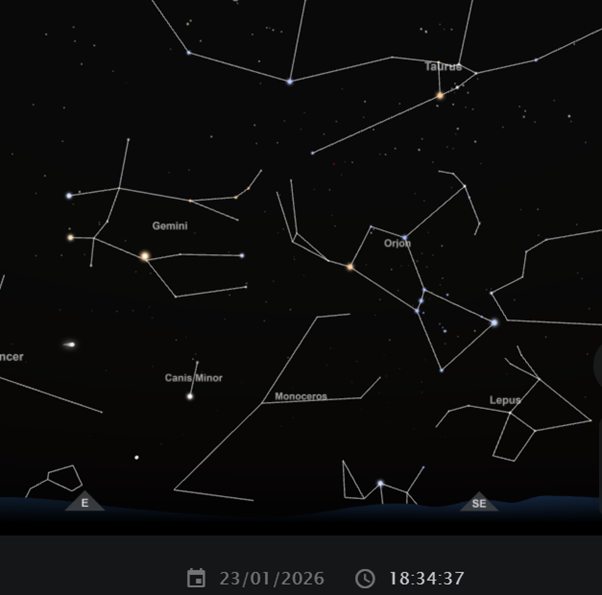
Figure 1: Gemini at 18:30 on January 23rd. See how it is positioned near Orion and the small dog Canis minor below. It is easy to confuse Canis minor and the Gemini twins. Remember the twins are closer in brightness to each other whilst Canis minor has one very bright star, Procyon, and a dimmer star Gomeisa. The very bright object in Pollux’s hip in Jupiter.
Meteor Showers:
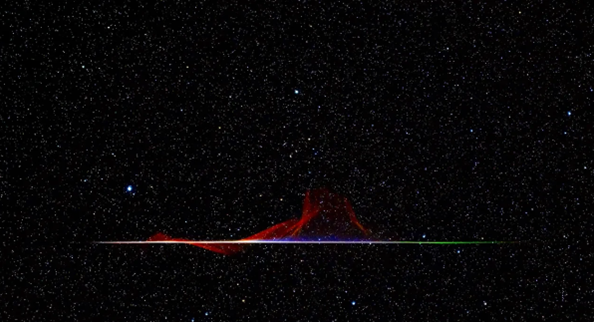
Figure 2: A colourful Quadrantid meteor by Frank Kusaj, winner of the Astronomy Photographer of the year 2021.
On January 3rd-4th the Quadrantids meteor shower peaks. However, this is a pretty poor chance to get a bit of luck for the new year as it falls on full moon night which will cause a lot of natural light pollution, making it difficult to catch weak flashes of blue light streaking across the sky. It is a fairly good hourly rate of shooting stars, with the maximum being 120 meteors per hour during the peak of the shower, but this only last a few hours. Remember that is in reference to the best scenario: dark, clear night conditions. So even with a full moon it might still be worth a few hours sat out with a blanket and mug of hot chocolate and welcome in the new year with a bit of stargazing magic.
Planets:
This month we do have all the Gas Giants ganging up in the sky, but Jupiter is the brightest and it is at its best, reaching opposition on the 10th. Opposition means that it is directly opposite the sun so appears lit up at its best for us. It takes around 13 months for Jupiter to go back to opposition so this is the best brightness until February 2026!
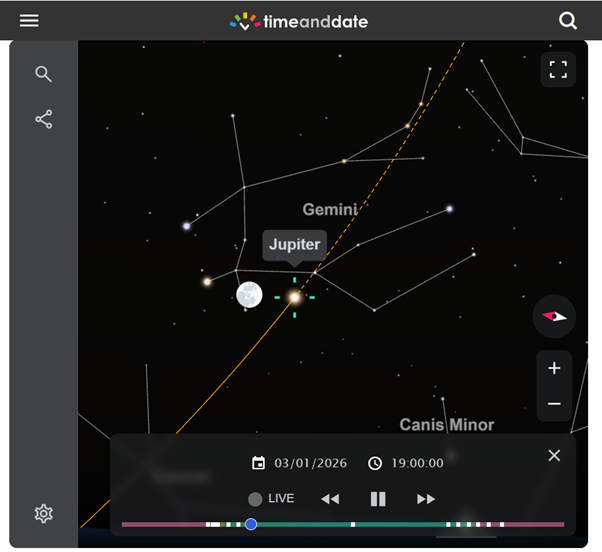
Figure 3: Taken from timeanddate.com. January 3rd position of the Full moon and Jupiter in the constellation Gemini.
Saturn is also in the sky this month, visible in the early evening over the south. Remember planets do not twinkle, stars do! So use that to check that the brightest point of light you think is a planet really is a planet. This is because planets are closer to us, within our solar system whilst other stars are far beyond the reaches of our solar system, dotted across our galaxy. Planets appear bigger and brighter on the sky, unless they are Neptune and Uranus which are dimmer and need binoculars or a telescope to be seen by our weak human eyes.
The two blue gas giants will appear as iridescent blue dots, compared to the shinier twinkling white stars that surround them, I like to think the comparison is the same as a diamond and a pearl, the stars being diamonds and the planets being pearls.
Neptune will be right above Saturn throughout the month, so if you can find Saturn you can use it as a stepping stone to finding Neptune. Uranus is a bit of a harder spot, situated in the constellation of Taurus the Bull, underneath the Pleiades cluster, the heart of the Bull.
Moon:
The moon is in some excellent viewing and picture-perfect spots this month:
On the 3rd of January the moon and Jupiter will be close together in Gemini, and on the 23rd the moon will be hanging out with Saturn and Neptune sandwiched between them in a traffic like stack. On the 30th the moon catches up with Jupiter again so a second chance at a Gemini-Jupiter-Moon shot, though this time the moon will be only 92% full, so a tiny sliver of the terminator line will be present on the edge. This will be a truly beautiful sight and an easy to point the telescope in the right direction night.
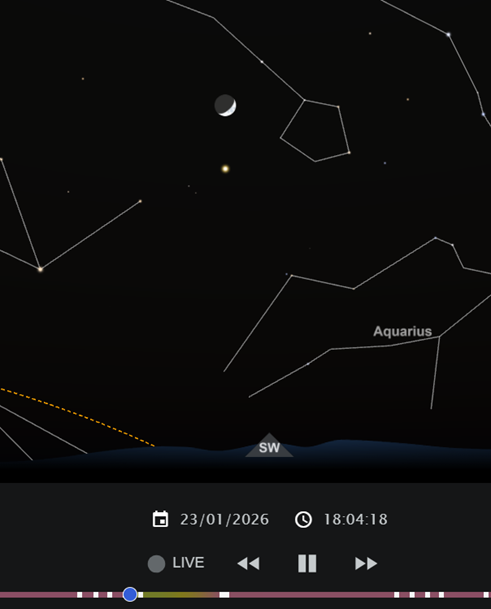
Figure 4: Moon, Neptune, and Saturn on the 23rd of January in the evening sky after sunset. Taken from timeanddate.com
3rd: Full moon
10th: Half-moon :Third quarter
18th: New moon
26th: Half-moon: First quarter
January’s Dull moon is called the “Wolf moon”. This is thought to have old Celtic and English origins from when wolves ran wild through our wilderness, some of the only nature still visible in the cold deep winter. Hopefully you don’t come across a wolf at full moon this month!
As always, wrap up warm, give your eyes time to adjust to the dark, and enjoy the winter sky. Clears Skies and Happy Stargazing!